Fifty years ago today (11 August 1976) two impressionable undergraduate geologists make an exciting discovery on Gardevarre mountain in Finnmark, Arctic Norway. Challenged by the barren land, the Arctic winds, and the spectre of Norse mysticism, their time in Finnmark becomes a test of resilience and conventional beliefs. One eventually tells his story, after returning to Finnmark in 2016. Can their lives ever be the same again?
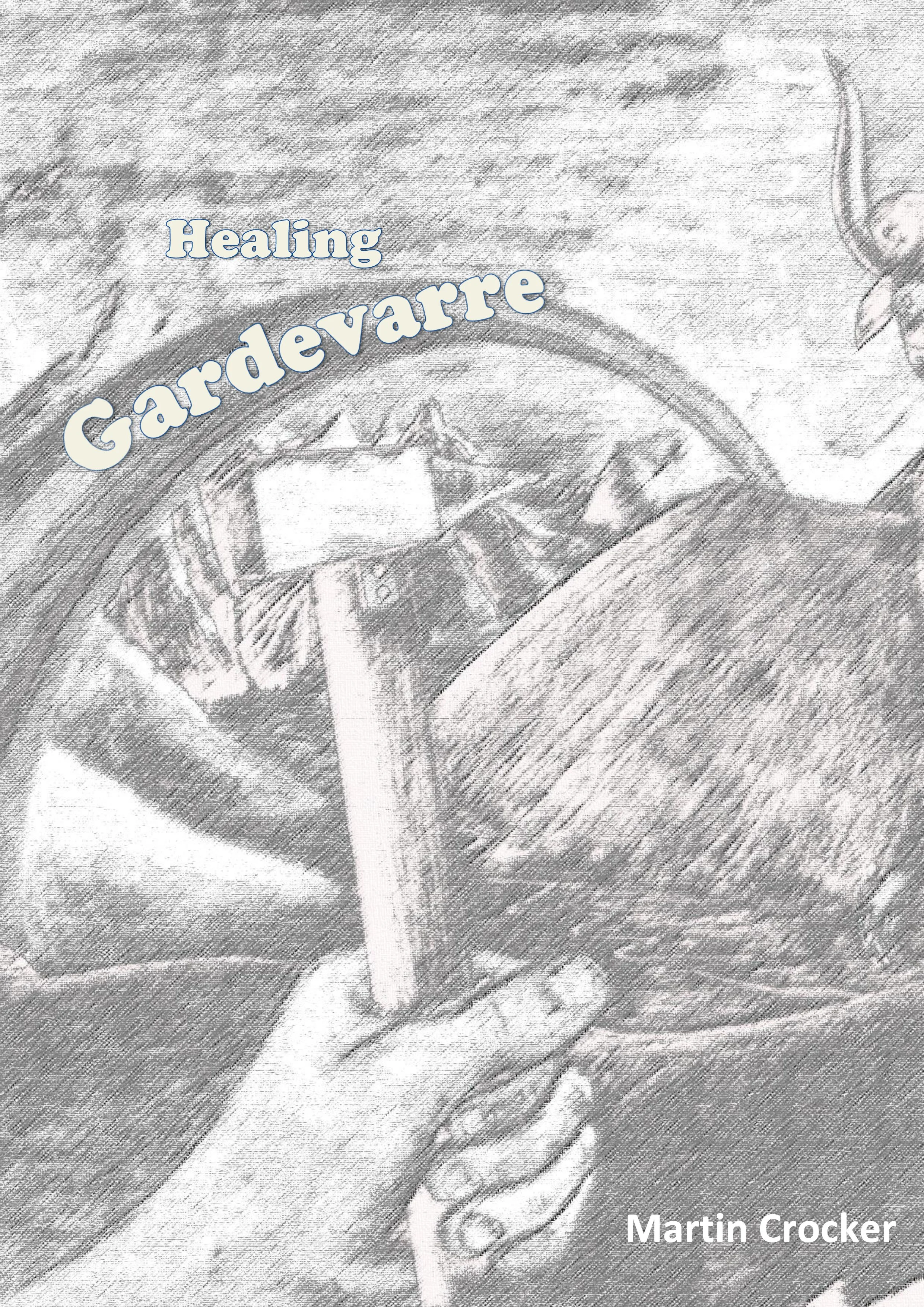
Healing Gardevarre
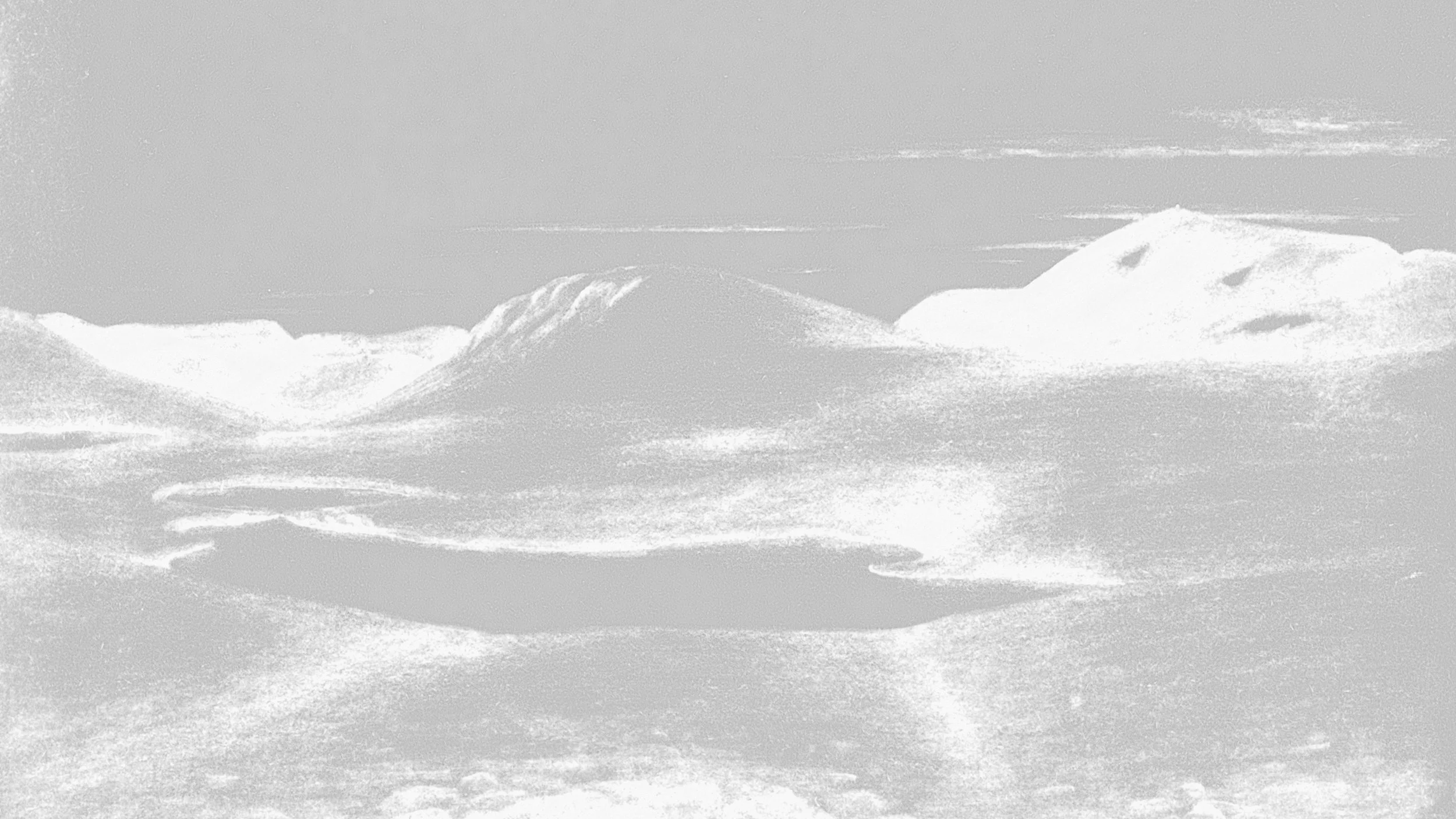
Gardevarre (far right) and Davebrassa (centre), sketched from the NNE; August 1976
I will never, ever come back here.
It’s May 2016. My heart jumps at every bang and bleep of the plane as my wife and I cross the North Sea towards Oslo airport. Our precious cargo worries me. We are anxious flyers at the best of times. An irrational fear takes hold. A fear that the role of our cargo in a warring ideology, mysterious cultures, and foreign landscapes – serving first as an instrument of war, then as an object of disdain for the Sami, and now a mere collector’s piece – might assert some dark force on the pilot’s judgement, thus ending its journey – and ours. Who could know for sure that it had not evolved powers to bend reality, or interfere with physics, or skew probability – given its history of death, destruction, but ultimate disgrace and captivity? Disgruntled, this was our cargo’s final opportunity to complete its mission and down our aircraft in a last laugh for Nazi malevolence. Yet such were the risks of returning to Gardevarre, 40 years on.
Our journey was one of reconciliation.
I tried to sketch Gardevarre from Mystisk Topp, but after 25 minutes my hands chilled to stone.
At 1.00 a.m. in a faraway land a soundscape of nature’s power was brewing in jealous rage. Wicked northerly winds crash through Porsangerfjord, raking the massive sandstone escarpment high above, and plucking the guy-lines on my tent like atonal pizzicato until one by one they snap – and the tent is left clapping. This was bleak beyond bleak. And the bleak then turns to black to thwart the good intentions of the midnight sun to restore light. Darkened, Camp Crocker sinks into a hollow of loneliness; destitute, almost bereft of hope, now bombarded by the Arctic’s reckoning – in this wilderness of icy winds. Yet with great reluctance I commit to get out of bed to make repairs, lest my shelter becomes airborne and me naked. But when halfway out of my sleeping bag I hear a life scratching at the tent: someone or something was out there! At least I think so. A week alone had unshackled my imagination but unleashed the busybody agents of paranoia. What in the hell was it? Could it be the thing that had been following me on the mountains over the last few days? Or maybe it was my angst that had taken physical form: that damned half Viking, half beast again. Frantically I search for my knife amongst the ubiquitous moss and the magazines, the cans of sardines, treacle puddings and Santana tapes. I find it but, despite Carlos egging me on with A Love Supreme, I cannot muster the courage to unzip the door to face whatever it is or will become outside. So I ‘shout it out’ like Uriah Heep and bang on the tent from inside, shaking with the adrenalin of confrontation and the impending showdown. ‘Come on then; I don’t give a shit!’ Come on!’ – somehow that battle cry morphing into a jolly singalong of ‘One man went to mow’. But there was no refrain or jeering – at least none that I can hear – and so a heartbeat solo takes command, drowning out everything else, even the wind. Maybe this is what comes of having a love dream about a mountain.
Now 8.10 in the evening and Elton thinks ‘it’s gonna be a long, long time’ – I tend to agree with him.
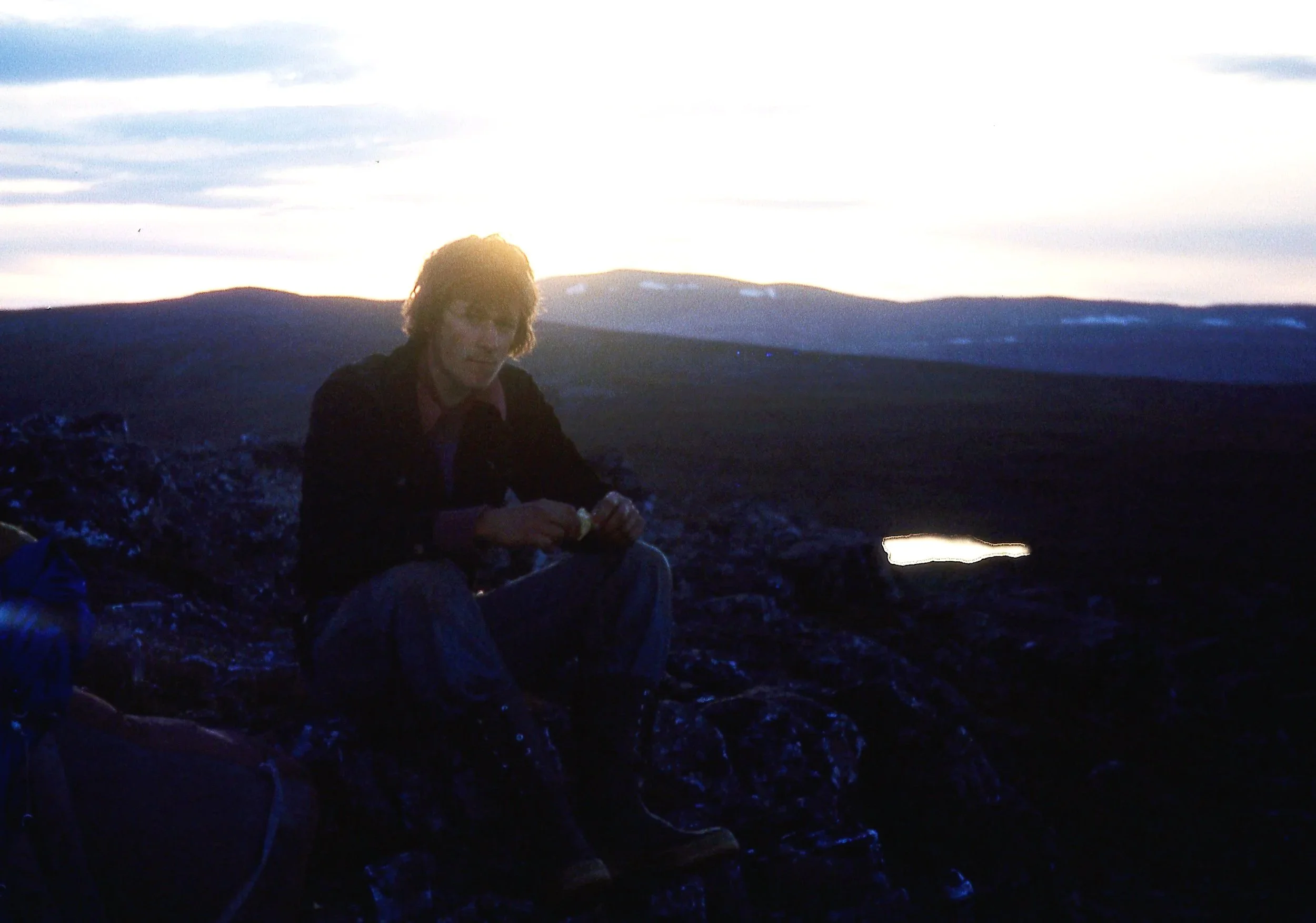
After an uncharacteristically early start, more mapping was in order for day 30 of Cardiff University’s 3-month undergraduates’ 1976 expedition to chart the geology of an area of Finnmark in Arctic Norway. It is a quite beautiful place, really; on the moors, roaming. But while hunting for outcrops I quickly learn that beautiful doesn’t have to be beautiful. For in fine weather and in emotional control (more or less), its space becomes freedom, ‘desolate’ becomes unspoiled, and forever-light becomes a fuel for the interminable legwork and mind control, ten to seventeen miles a day. And I wasn’t naïve enough not to realise that the acid test was always going to be psychological rather than physical: to find ways to embrace zero human contact for this two-week stint alone in the field. This cannot, I reason, be quite as bad as solitary, because I can see the coast road, not so far away. But in reality the road offers only the most fragile of reassurance as camper vans pulse towards Nordkapp, their pilgrimage almost complete. And then there are the reindeer – hundreds and hundreds of them – although I soon learn that talking to reindeer doesn’t help me much either, and they mostly only run away when I try.
But today I am feeling upbeat – this is to be my first day on the high moorland or the ‘inner plateau’ as I call it; a milestone. My objective is Lake 368, labelled thus in our map prepared by the US Army Service in 1953, presumably a post-war international project to plug informational flaws revealed by World War 11. Between me and Lake 368 however rose the omnipresent escarpment that hangs over this part of Porsangerfjord and my campsite – a giant brooding fortress of metamorphosed sandstones and shales entreating all but the reindeer-herding Sami to ‘keep out!’ I quickly discover a ridge behind my camp called Skaw which supplies a taxing route of ascent in the morning heat; I hadn’t expected such high temperatures in the Arctic or that they would be served lovingly with a mizzle of mosquitoes, potent to the last. En route I stop with my clinometer to take measurements of the dip and strike of the indigenous pelites and psammites, happily leaving the grander reasoning for higher minds at a later time. For in this role I am mostly a fact-collector of the minutiae of the lineage of folds, augened porphyroblast garnets, and the alignment of boudin to help evidence how this once-tormented region of Earth had been eviscerated and structured by thrusts and recumbent super-folds or nappes (which, I was to learn later, had a habit of interfering with chronology and my tepid assumption that rocks got younger with height).
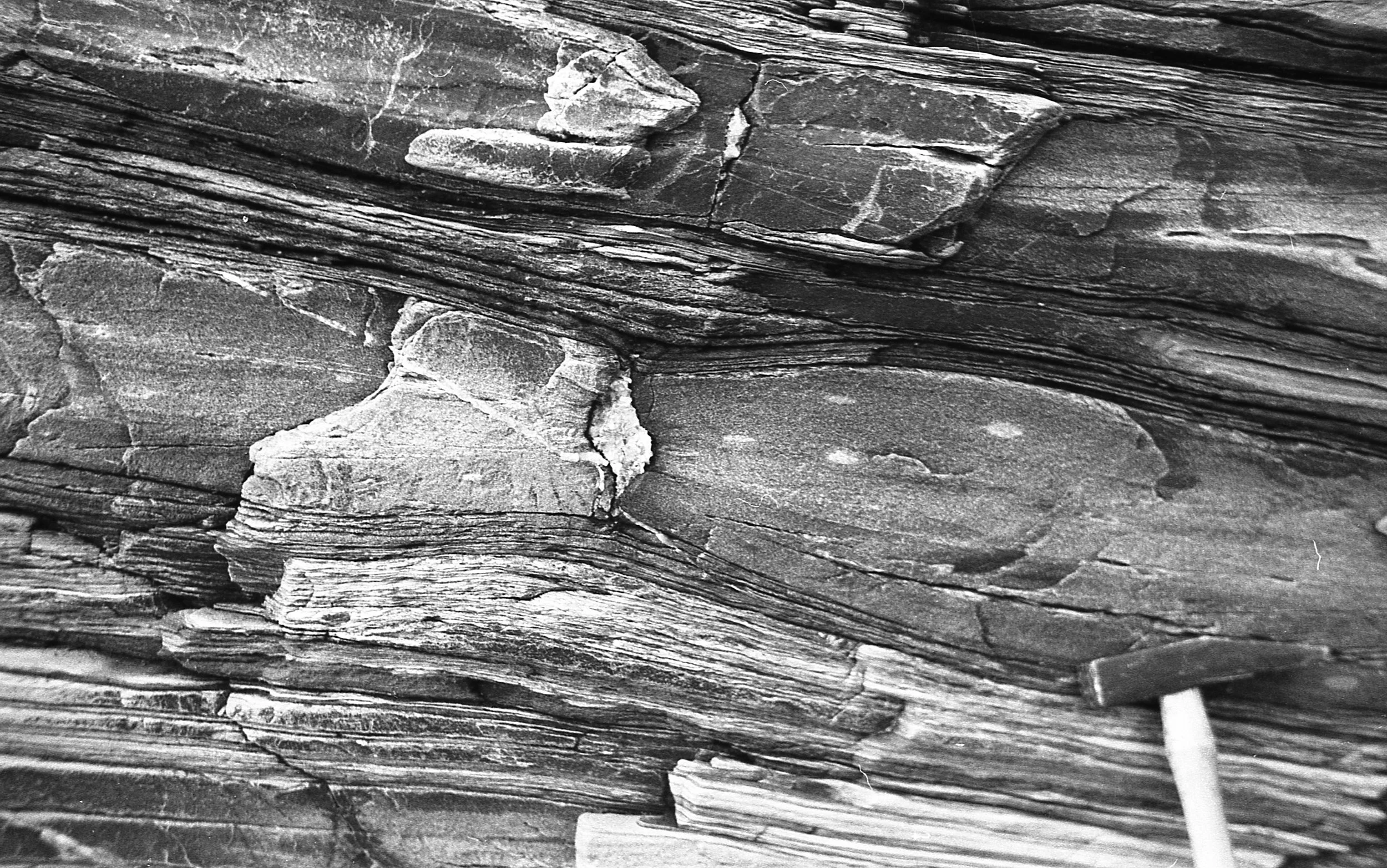
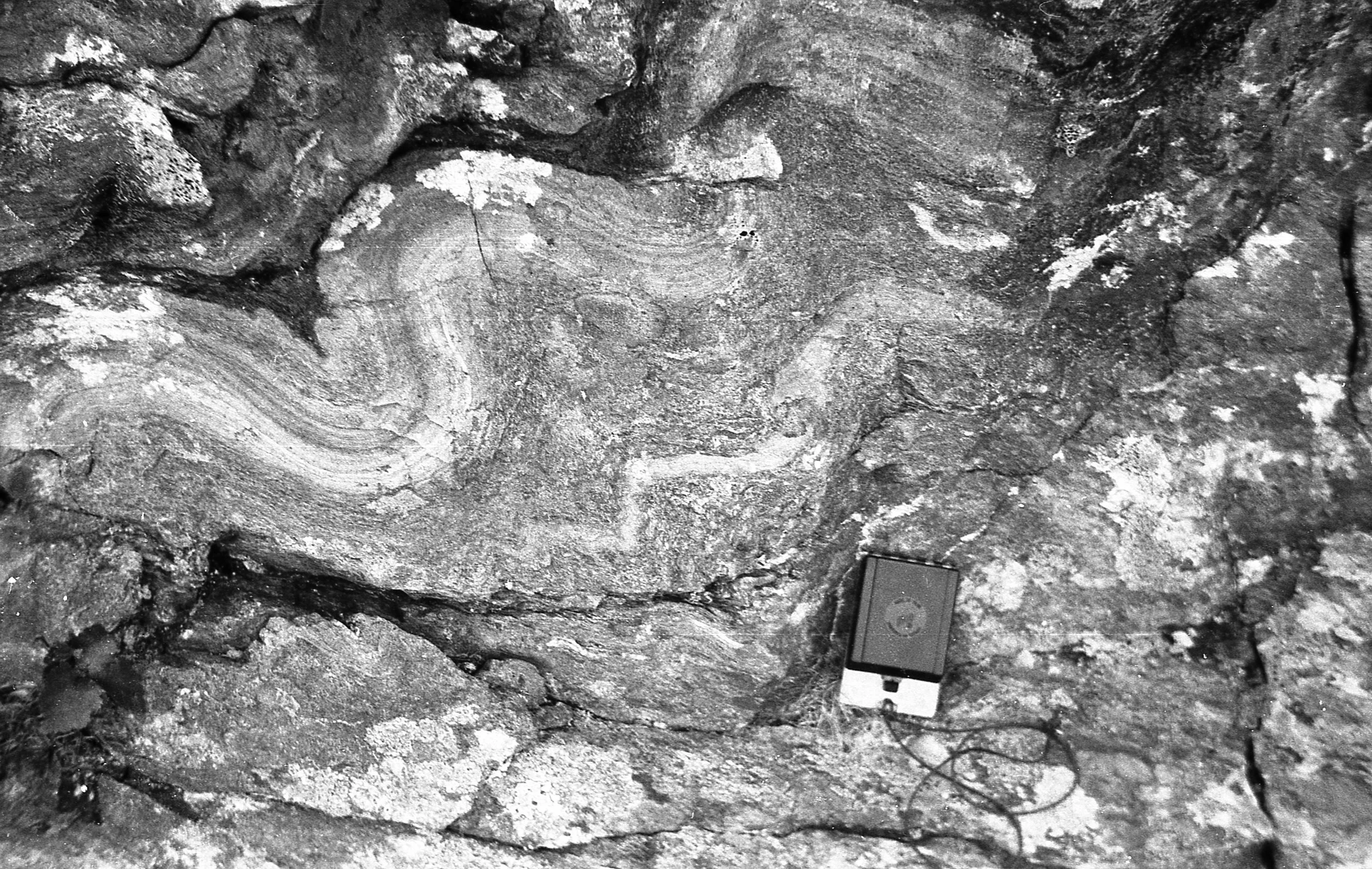
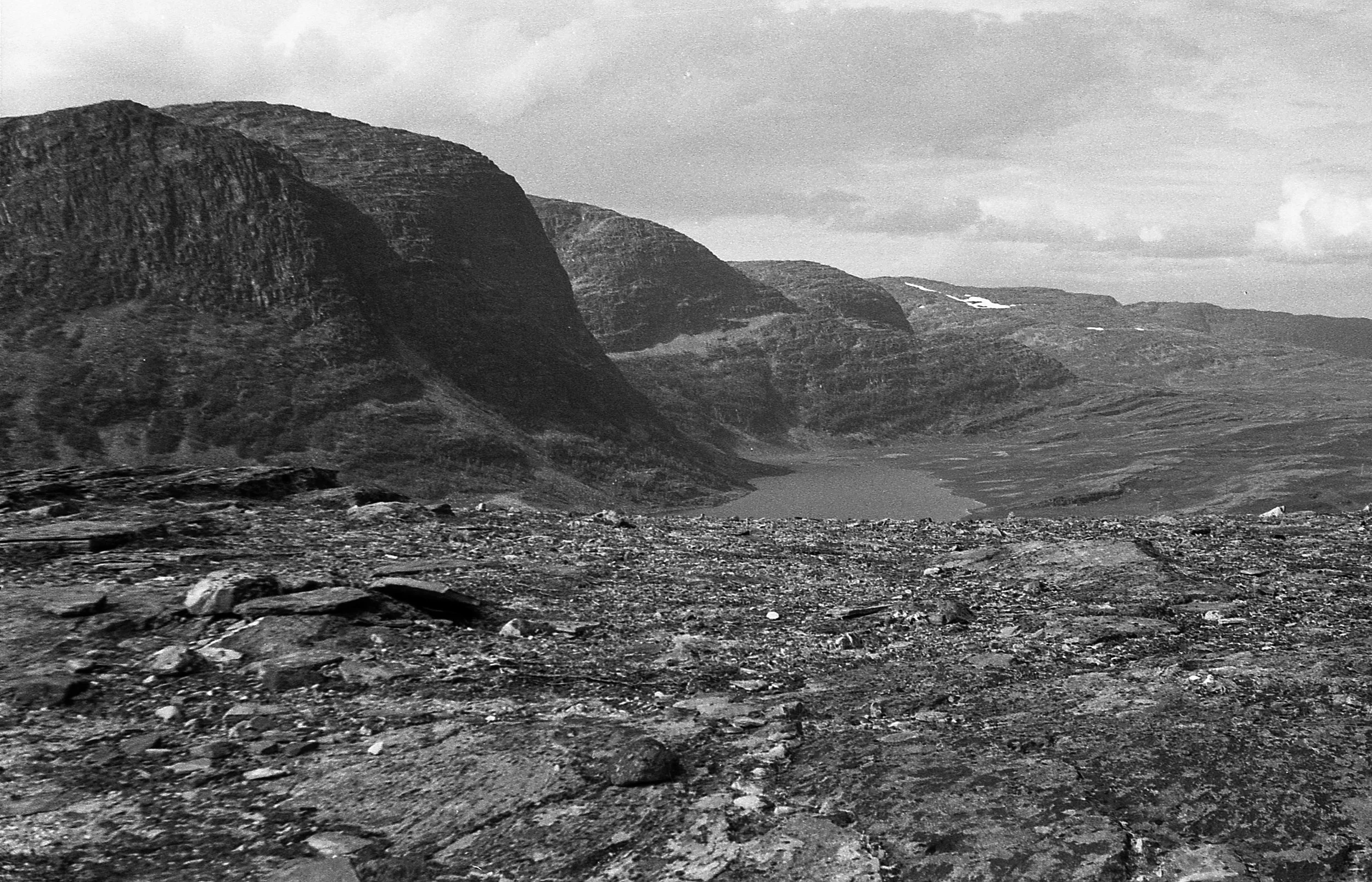
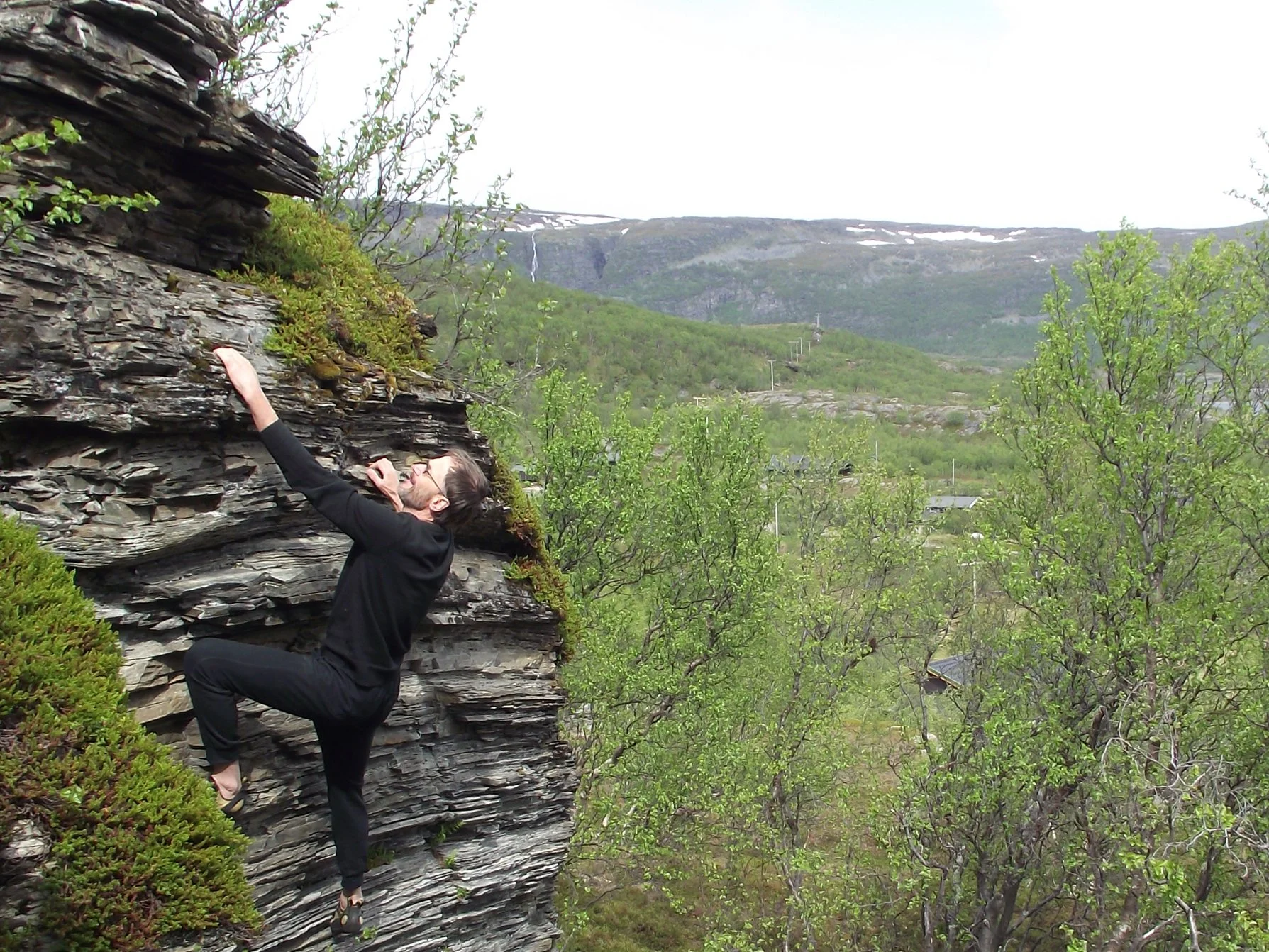
Curiously, but soon, I discover that geological mapping has an art about it; the need to think in 3D and picture what might be going on buried deep below the surface, and under my feet. Initially it adds to the confusion of a ragged and impressionable young mind unaccustomed to a grant of freedom to think beyond others’ boundaries. Confusion comes too from the sun rising every morning by 1.30, and the corresponding redundancy of the substantive day/night unit of time – surely an essential fabric of a sustainable mind and body. Yet the absence of total darkness has its advantages like a few weeks ago when the inharmonious snoring in the cabin gave me the excuse to escape with pencil and paper to sketch Porsangerfjord, in peace, at 2.00 a.m., and on another occasion to go bouldering in the midnight sun on my local slate outcrop. (Sleep is over-rated anyway.) Such night-time forays helped me break away and connect with the zeitgeist of the place, but they left me confounded by the scorched earth tactics of the Nazis when forced to retreat from the Soviet advance to liberate Finnmark. For God’s sake this land radiates innocence, not hate! Back on Skaw, rested yet measurement-fatigued, I push on metronomically towards Lake 368, the top edge of the scarp at last underfoot. That’s where I gaze upon Gardevarre for the very first time.
Will I manage to eat a whole treacle pudding tonight? Yes you did eat that bloody great treacle pudding all by yourself; well done!
When I last saw him, Nigel was going mad; yet perhaps no madder than me. But he only has himself to blame: this is the last place where anyone should be reading The Lord of the Rings, or in my case listening to psychedelia and cosmic guitar. What is it about this land that is changing us?
In only three days I find myself violently swinging my hammer above my head while shouting and singing at the top of my voice. That night I had lit a fire and dragged over the car seat which we’d unbolted from our van to make my camp more homely. Slowly but incipiently the light fades around the cackling shaman. Mists roll over the cliffs and envelope the reindeer still browsing for lichen and grass amongst the heather and silver birch. Embers spit and crackle while John and Carlos enter The House of the Lord and an empty can of mosquito repellent explodes in the fire. No alcohol; not a drop, but I’m talking back at the land more now, standing my ground – deploying my own form of joik using paradiddles with sticks on upturned saucepans. I conclude that being stranded here is an exemplary insight into how Norse mythology evolved to make sense of lands like these – and foster belonging. ‘Got spiritually entombed in the black gorge of the Taaraeana today, evil was lurking here, everywhere. Naturally I start shouting at the people disguised as boulders, echoes of an act out of Shakespeare or maybe a noaidi; and – unamused – the menace skulks away and onwards to the sea.’ But getting angry at the land is tiring work so I am forced to slump into the car seat to rest, thanking the gods for my radio cassette player. Any available god will do; all I need is some TLC. If luck prevails the night will clear so I can tune into Radio Luxembourg and maybe fall asleep to the ‘top twenty’. Apparently there’s a heatwave in Britain. I think I’ll buy some tobacco in Olderfjord and take up smoking.
Threw my knife at a tree 30 feet away and it stuck in first go! Second throw I got a tree just to its left. Amazing!
Viewed from the east it’s a slender, graceful mountain – Gardevarre. At only 2077 feet high this ‘mountain’ would be called a hill back home. But in northernmost Arctic Norway different rules apply – Gardevarre can remain snow-clad well into the summer. At first sight it or perhaps she beguiles, part-shrouded in mists and snow patches, seemingly unreachable across a windswept plateau of lakes and marsh, heather-clad moorland and Arctic rolls of quartzite. She presides over the inner plateau like a true leader: never overbearing, but enigmatic and always beyond, offering support when needed while cradling her barren dominion. It was 22nd July and perhaps the silly dream had made me, a just-turned-20-year-old kid, go goofy. Fairy-tale or fantasy who knows, but nonetheless at first sight my whole self trembled at the prospect of climbing the mountain in a few weeks’ time. Then without warning it started to rain, the boundaries between lake and rock and rock and sky blurring as I became swathed in mist, losing orientation. A suspenseful orange glow begins to bathe the scene as a golden sphere, maybe Beaivi, burns a hole in the mist through which an escaping rainbow arcs over my head and into the waters of Porsangerfjord. What kind of place can this be that the laws of physics are supplanted by who knows what. ‘Gardevarre’!’ I yelled, in awe. Maybe it was a question rather than a plea; I can’t remember which. That night the storm hit.
After 7hrs of geology did some bouldering – all the problems (5c+, 6a, 5b, 5a, 5c+, 5c-, 5a, 5c) including a new one up the right arête. Very pleased.
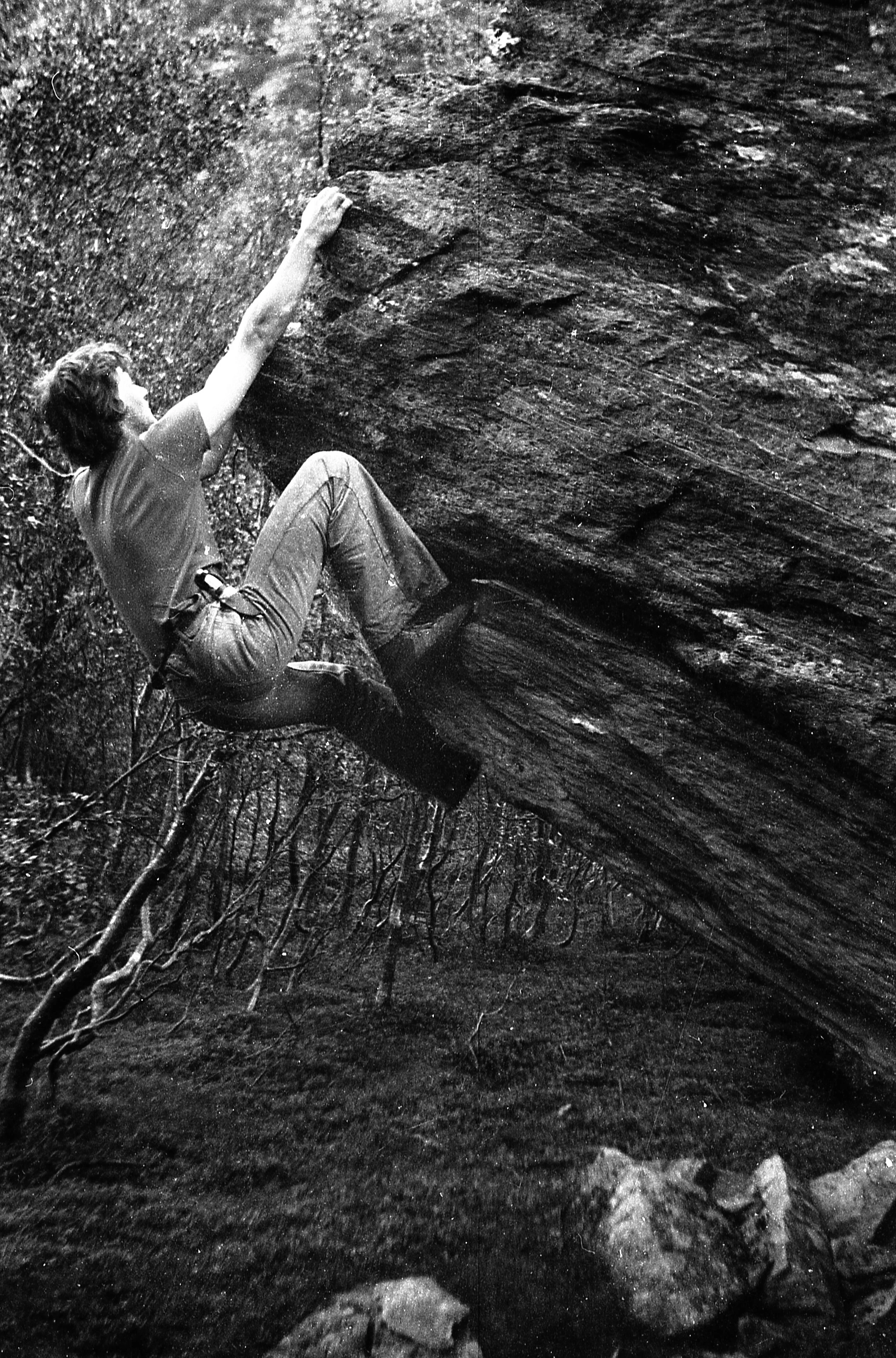
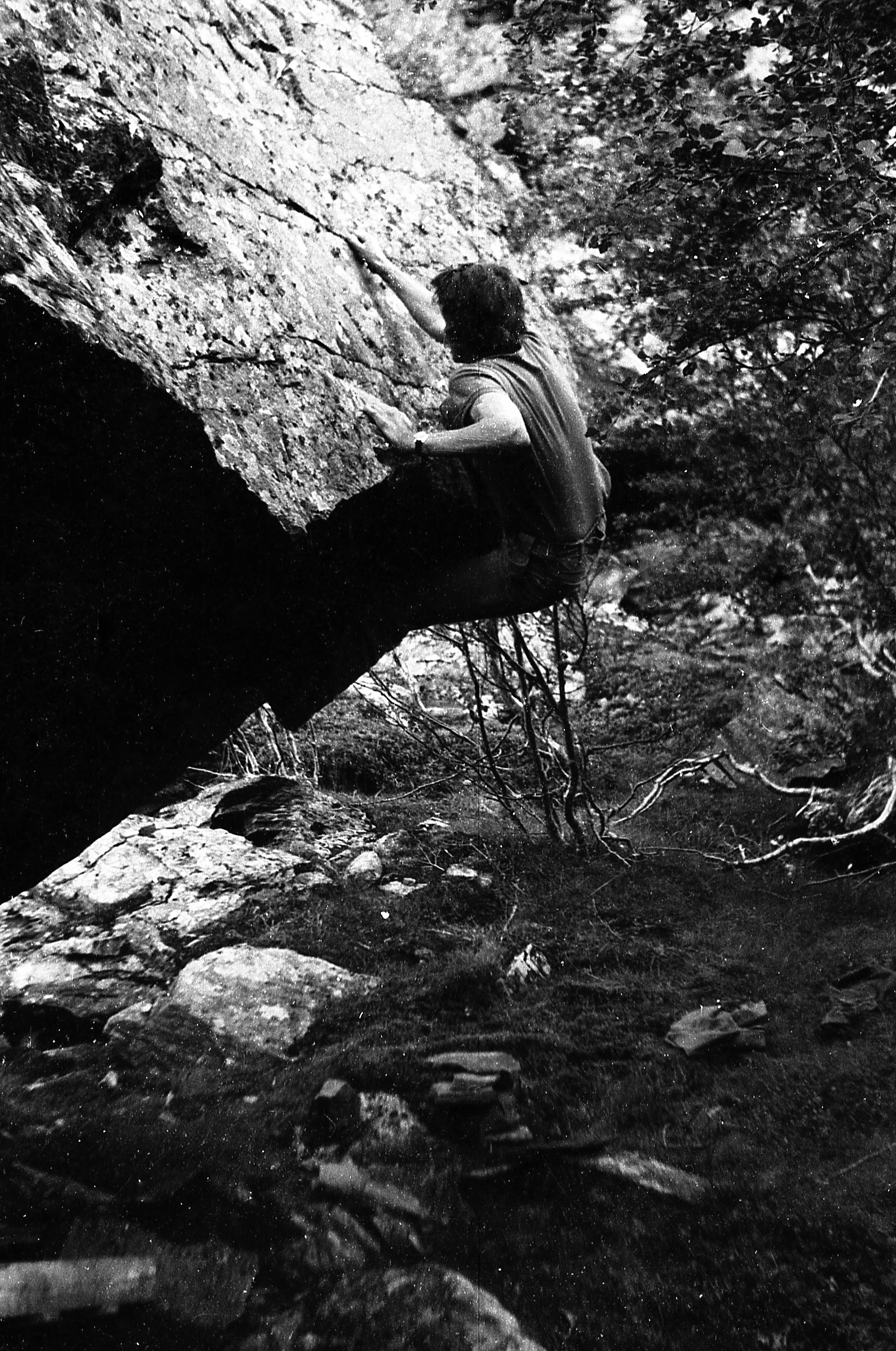
Skarvberget boulder problems, July 1976
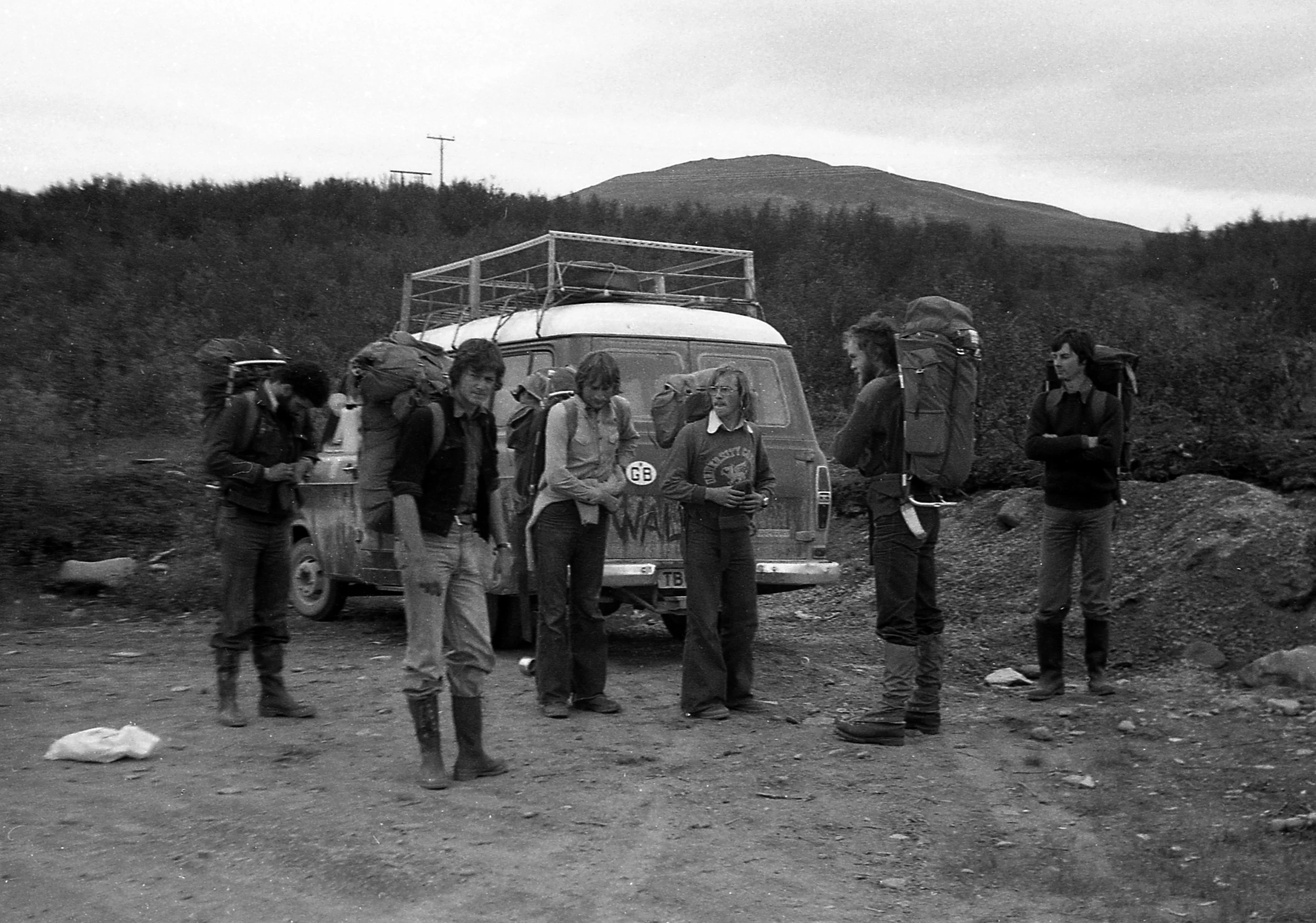
‘You two must be mad coming up here; there’s no way that we would’, agreed the other five members of the team while taking a rest. It’s Monday 9 August. The approach march of 7 miles to Lake 346 at the base of Gardevarre takes us four hours, all of us fully laden, keeling and cursing. Nigel and I are staying here for two weeks to complete our mapping of the western parts of our respective areas which include the southwest/northeast aligned ridge of the mountain. I take a picture in black and white: no loss; there’s very little colour in this muted monochrome landscape that some might reasonably describe as depressing. But it’s too late now for second thoughts – the commitment settling like a knot in our guts as our companions disappear over the hump of provisions they leave behind. Already we miss them, yet already we don’t. The strategy is that our campsite companionship will avoid us being sucked deeper into whatever mind-games this land had been playing on us. Loneliness, we’d discovered, is an attritional thing, otherwise waiting smugly to greet you every evening.
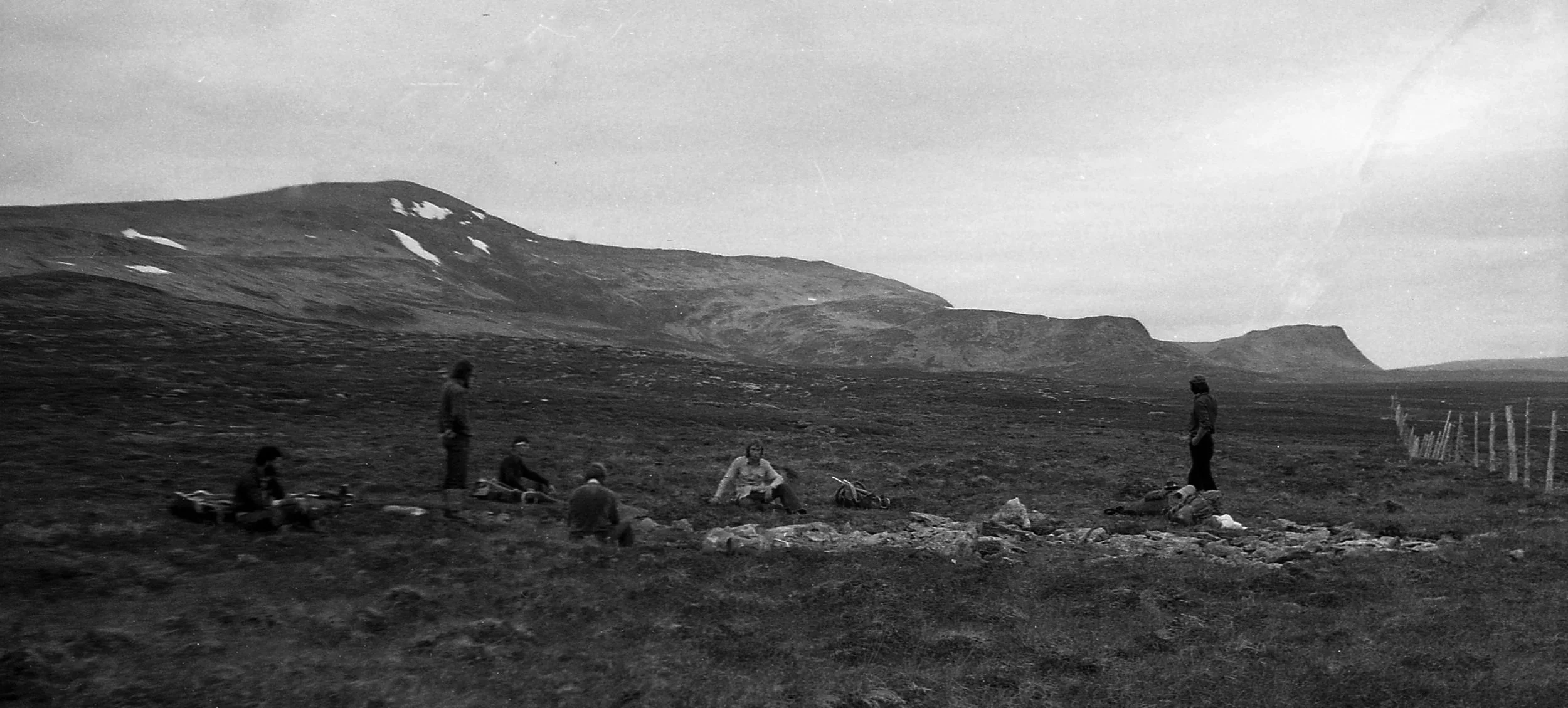
Almost there. From left to right: James, Paul, Sean, Nick, Tim, and Nigel, with Gardevarre waiting not too far beyond.
I penetrated further into the interior than ever before, singing. I have to admit that today the plateau felt friendly, and there was no sign of the ‘minotaur’. Maybe he’s a kindly Sami deity after all. A bird hovered overhead whistling, appreciating the company.
Of the mysterious Sami of Lapland I see nothing, but sense much. Yet only shotgun traces, echoes, shadows, ghosts. Their aura seems inseparable from the ground, the lakes, the rock, the reindeer. People don’t venture onto the inner plateau. No one. Or maybe we don’t see them.
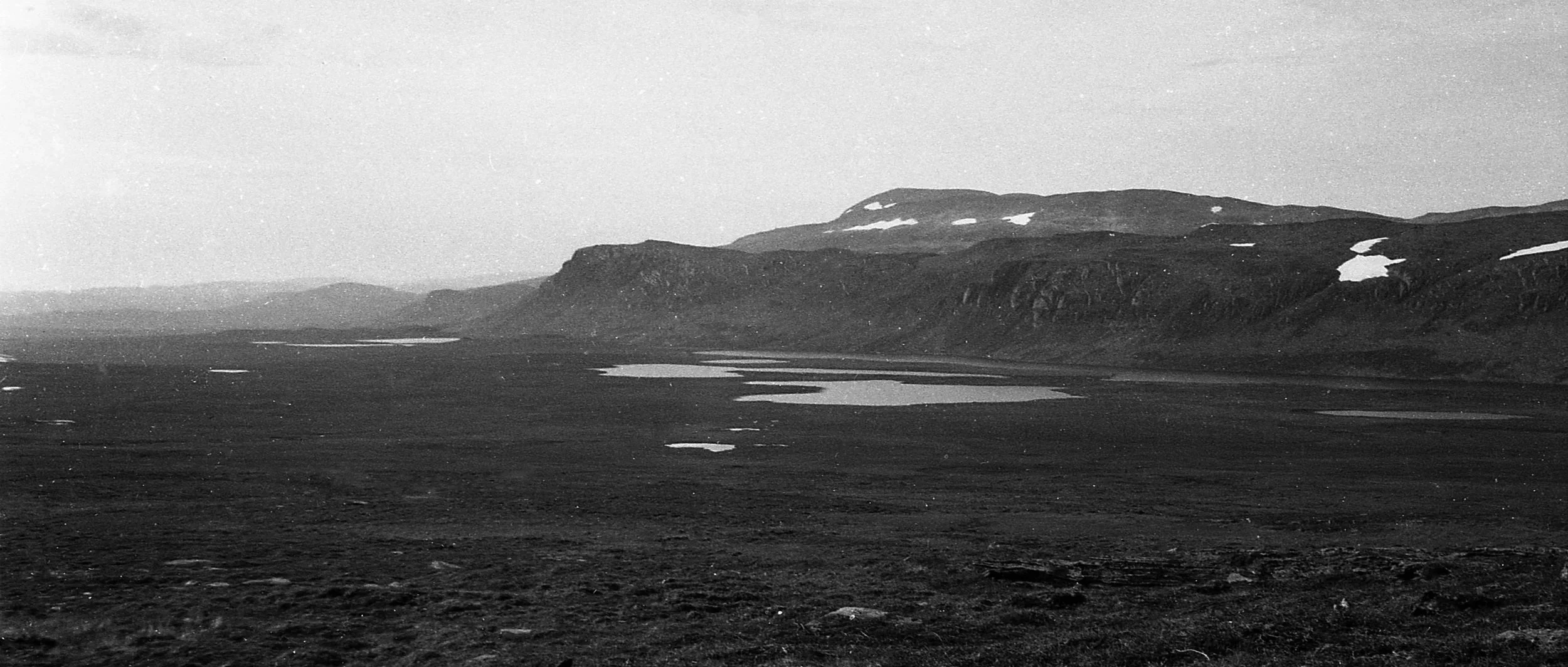
Looking south-westwards across the Russevatn to the scarp of Davebrassa and Gardevarre, August 1976
Finished my day by climbing a 60-foot high 45-degree snow slope. Welly boots no good for kicking holds but my knife acted as an effective ice pick so I wouldn’t slip down.
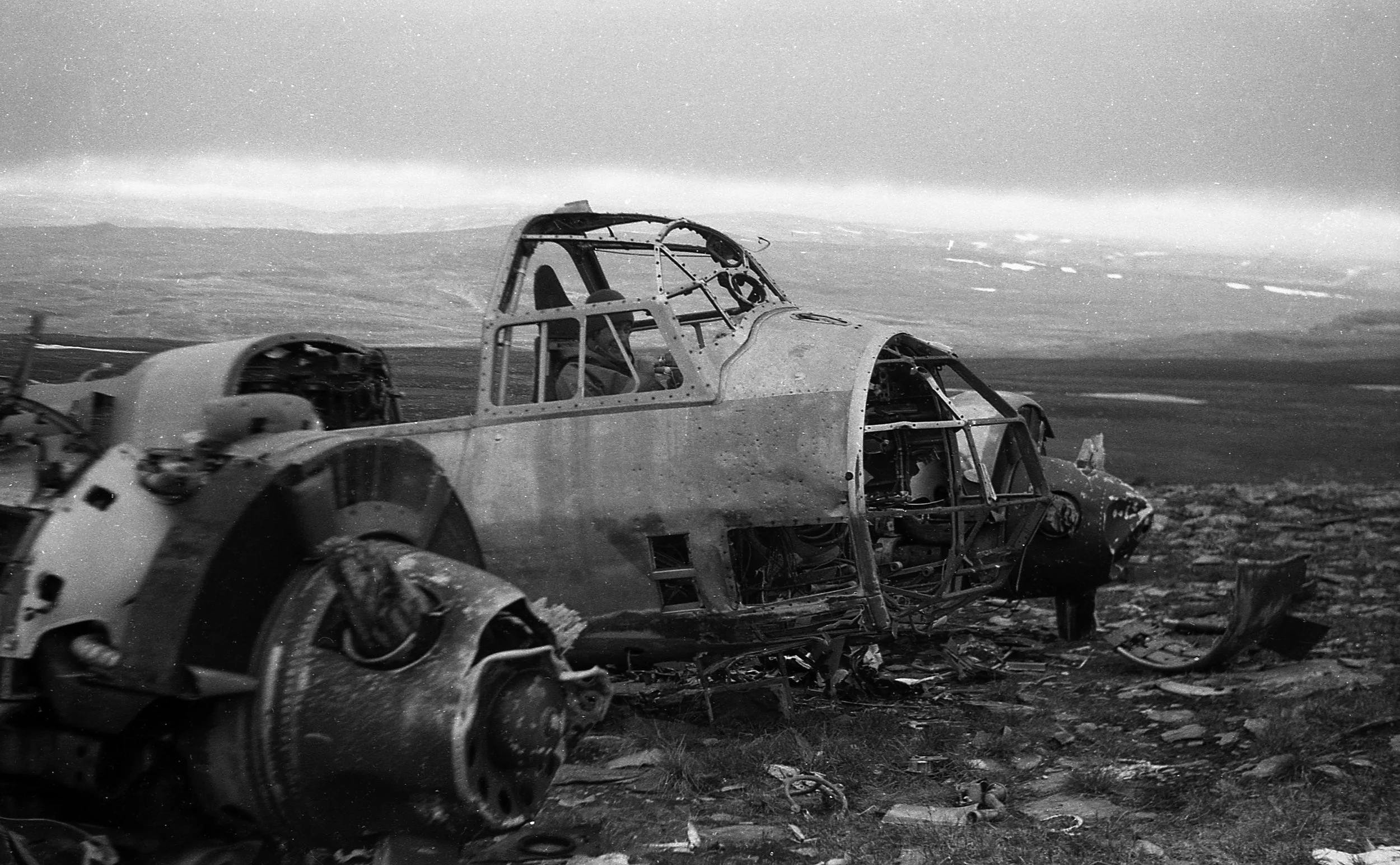
It’s Wednesday 11 August and a ring of mist grips the summit ridge of Gardevarre. We are both disheartened by the geology and the unstoppable cold, but decide to enter the mist and ascend the ridge north-eastwards on a recce. Before us, just below the mist-line, we see something manmade that should not be here, glinting. Speechless, we hasten towards it to discover a crashed aircraft. Unsettlingly I feel that I’ve been through this before – finding a plane on a remote ridge; maybe an old dream is being replayed right here and now. The aircraft is a German light bomber still carrying Swastika insignia on its fuselage and wings, seemingly in very good condition – only its guns, glass, propellers, and crew are missing. And the wheels are still in its wings, one engine had exploded (signs of fire), one wing had broken apart, and the tail section had scattered over the immediate hillside. But the fact that it is not a shapeless tangle of charred metal must surely mean it had somehow been steered to the ground?
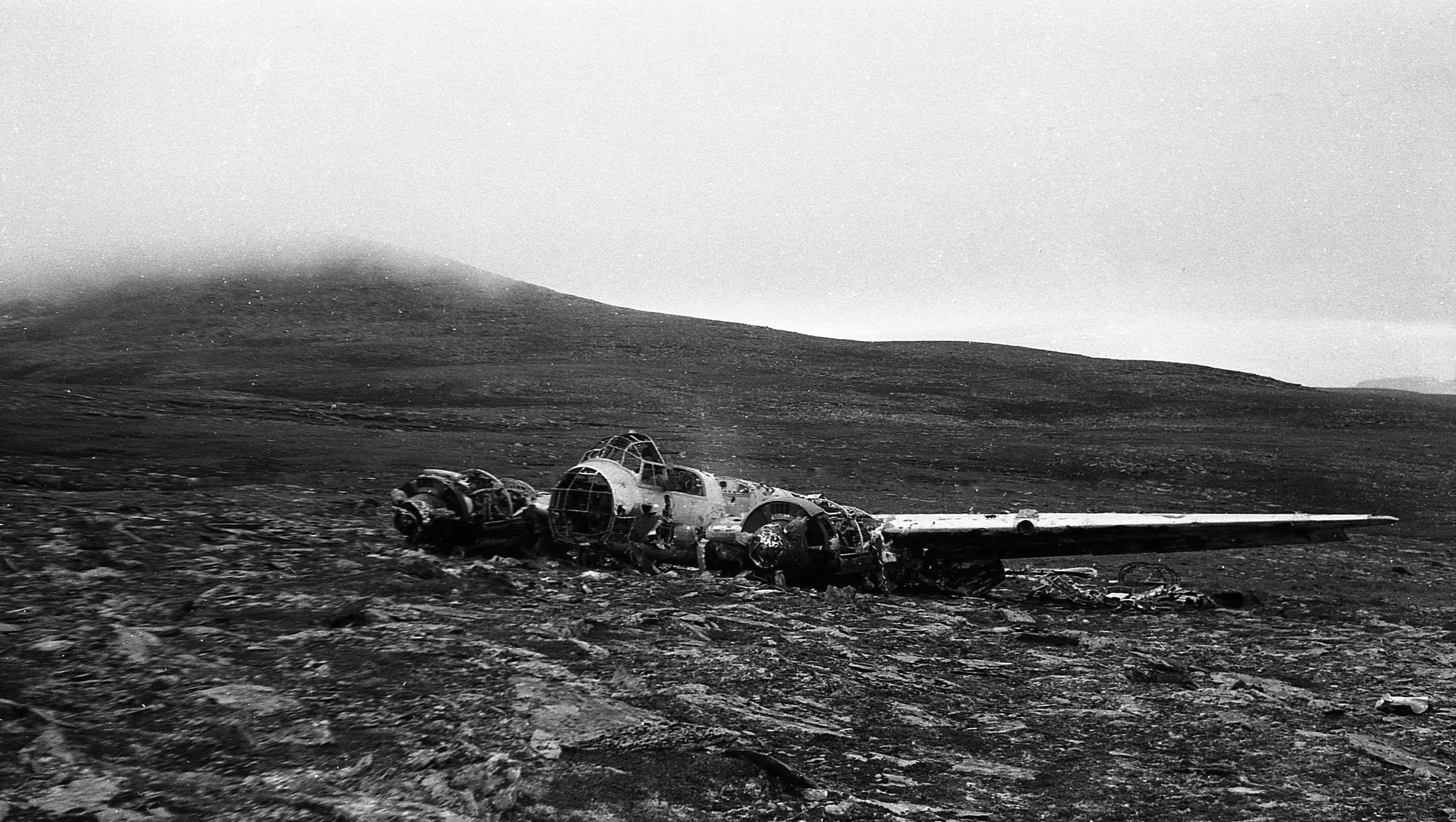
Junkers Ju 88 wreck approx. 1 km northeast of Gardevarre summit, 11 August 1976. The aircraft fuselage is northwest – southeast aligned (i.e. at right-angles to the Gardevarre ridge).
Walking around the site, we surmise that it was an emergency landing, perhaps caused by engine failure. Moments of quiet introspection follow. Only time displaces us from the German crew’s trauma. Thirty-five years on, ours was a sombre occasion – tinged with melancholy in consideration of the individual men who flew her, not the Luftwaffe, not the Wehrmacht – and certainly not the Third Reich. Who then were they, did they survive, and are they alive now? Yet up here it’s all too easy to mire in sentimentality; over the last month we’d become avid practitioners as the know thyself maxim ran amok. The result was that we had been left not knowing who the hell we were. In any case our sympathy may be misplaced: what order of destruction might this aircraft have vented upon innocent Finnmark or those trying to liberate it?
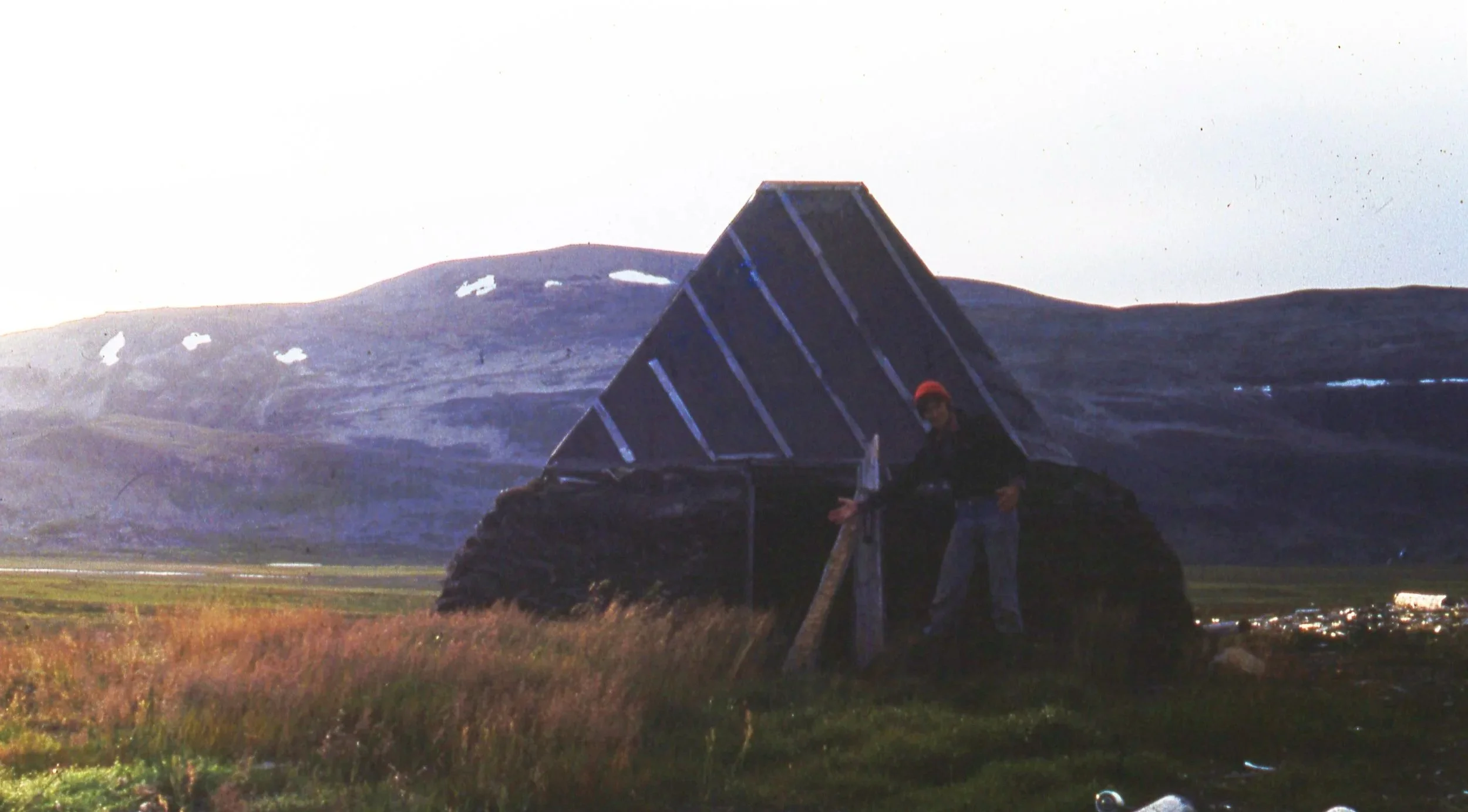
Next day in the middle of this wilderness we find a Sami hut – a bothy or shelter presumably for the reindeer shepherds in this region. Externally it is clad with wads of turf while inside is a thick bed of moss and twigs upon which is an imprint of someone who had been sleeping. On the wall is a drawing of an eagle soaring magnificently above the plateau. I don’t know what possessed me to think to sign my name on the back of it. I wasn’t the artist but I suppose I felt I could have been. I am sorry.
Realising the crash is quite a find, we pose for pictures in the cockpit; we’re entitled to do so since we’d long promoted ourselves from tourists to adventurers. But – comfortably seated in the pilot’s chair – when I say ‘cheese’ and pull up hard in mock flight, the aircraft’s steering wheel comes away in my hands. ‘What has happened!?’ After fiddling around with it for a while I decide I cannot fix it back on, so I take the steering wheel away from here as a memento. There was no guilt in doing so, no rationale; just a sense of salvage, perhaps effecting a spiritual payback for what we have had to endure.
‘I wonder if we are the first’, Nigel asks? We agree it unlikely we are the first non-Sami explorers to visit the crash-site, but nonetheless we are surprised the aircraft is still here, relatively intact: Gardevarre and the Sami gods will have wanted this damned war machine off their backs a long time ago.
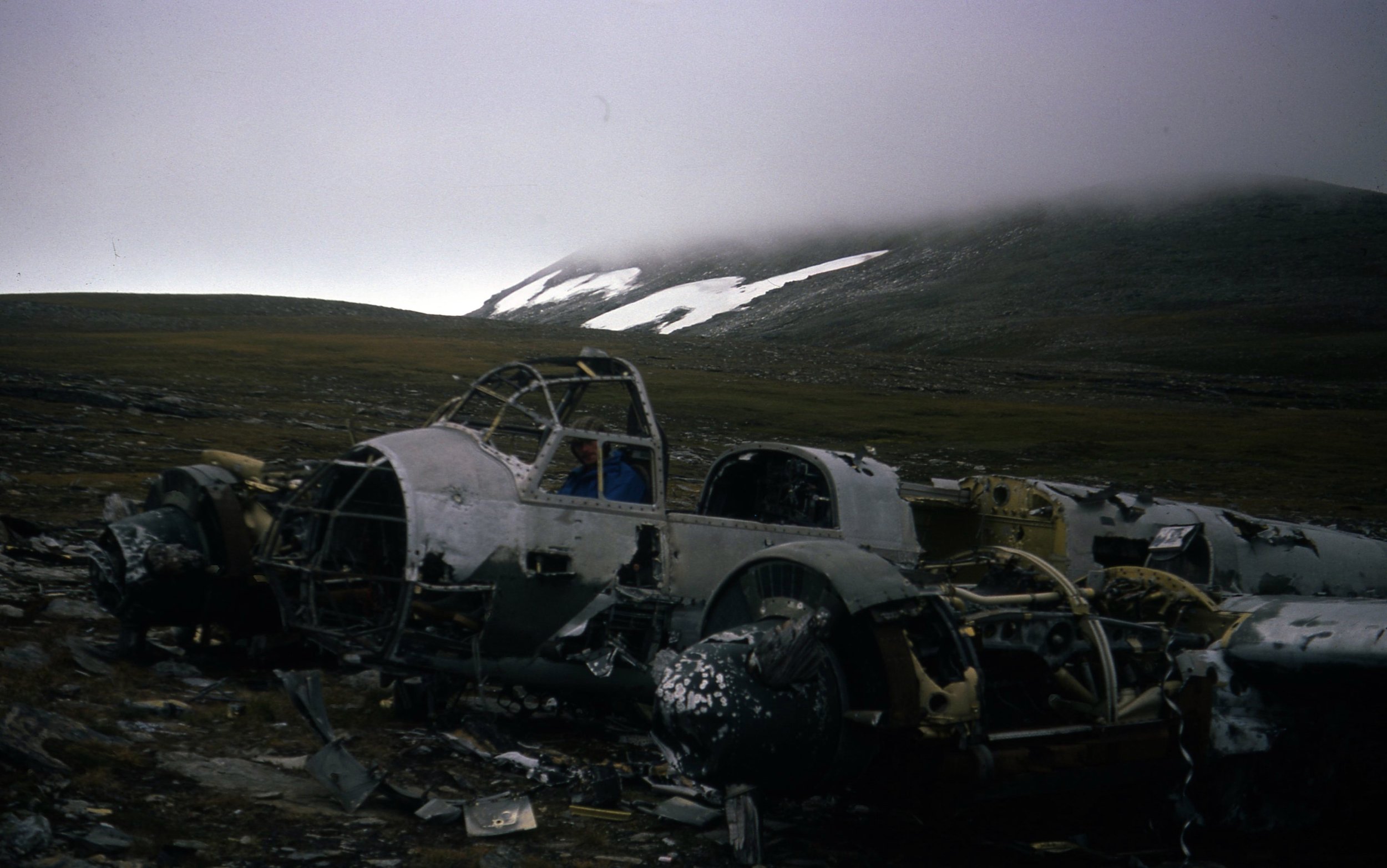
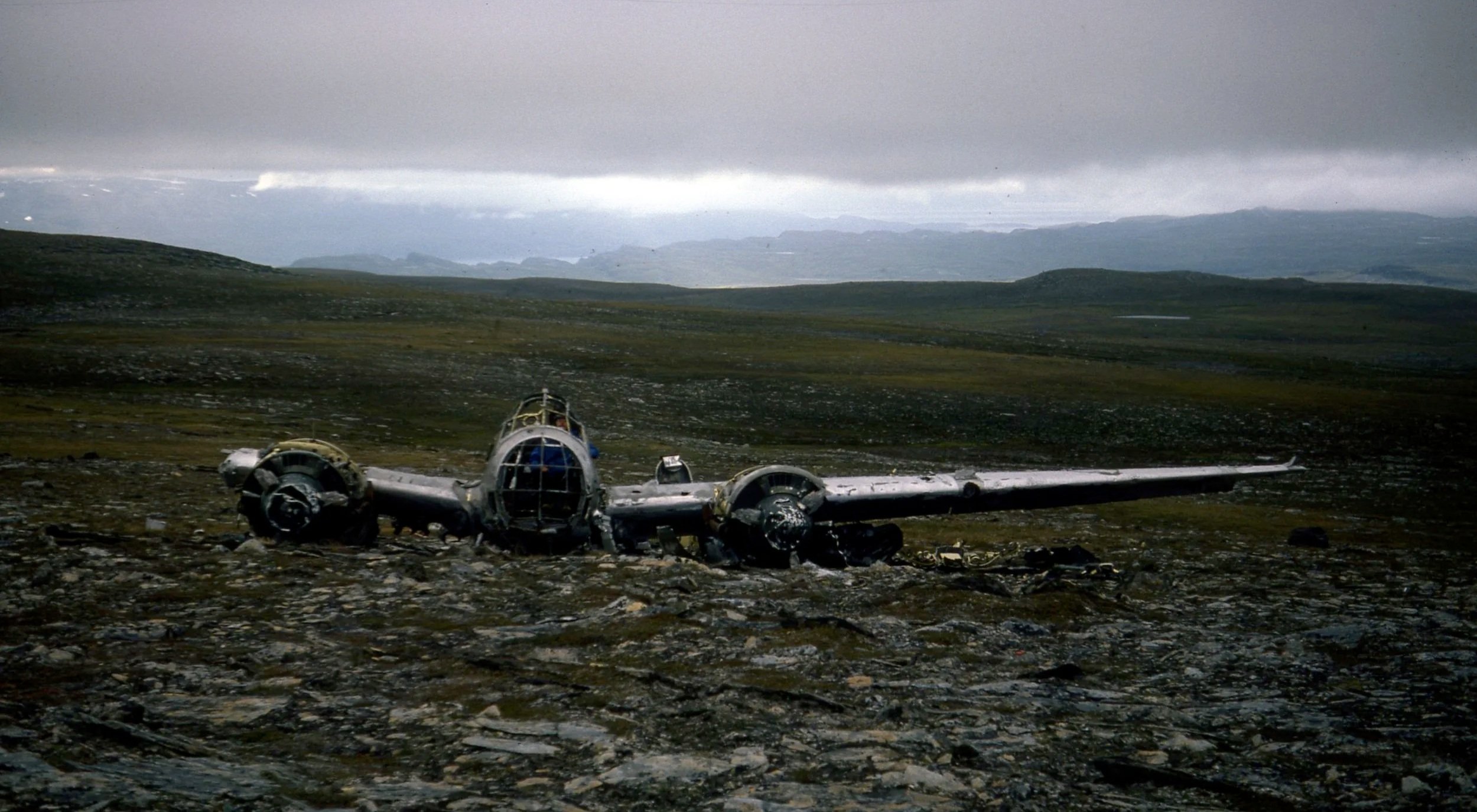
The broken-off starboard wing lies a little out of view on the hillside.
I have spoken with the sky this evening to find God
The following day I got ‘really pissed off’. Somewhere in the wilderness at one of the countless rock outcrops on my 15km excursion I had lost my Stubai climbing hammer. Without it I felt unprotected, as Thor would have done without his. It had been at my side pretty much since I’d started rock-climbing in 1970. The spirits here will have seen me carrying it. But now I am not, and things have changed; like there’s something to be reckoned with in this land. And I know what it is. That downed aircraft – an historic interloper and anomaly – is preying on my mind, infusing a torment that is hard to define, and twisting the spiritual landscape with its morbidity. Or is it merely that we had barged in without due deference and unwittingly got ourselves on the wrong side of the Sami spirits? Next day the anxiety and palpitations return and I cannot breathe properly. I’ve been thinking for weeks I have shingles, though more likely I’ve become unhinged and neurotic – still vulnerable to culture-shock hallucinations. I wonder how Nigel is faring two miles to the south, alone? He has had it rough too. This morning he looked like he’d had a fight with a couple of reindeer.
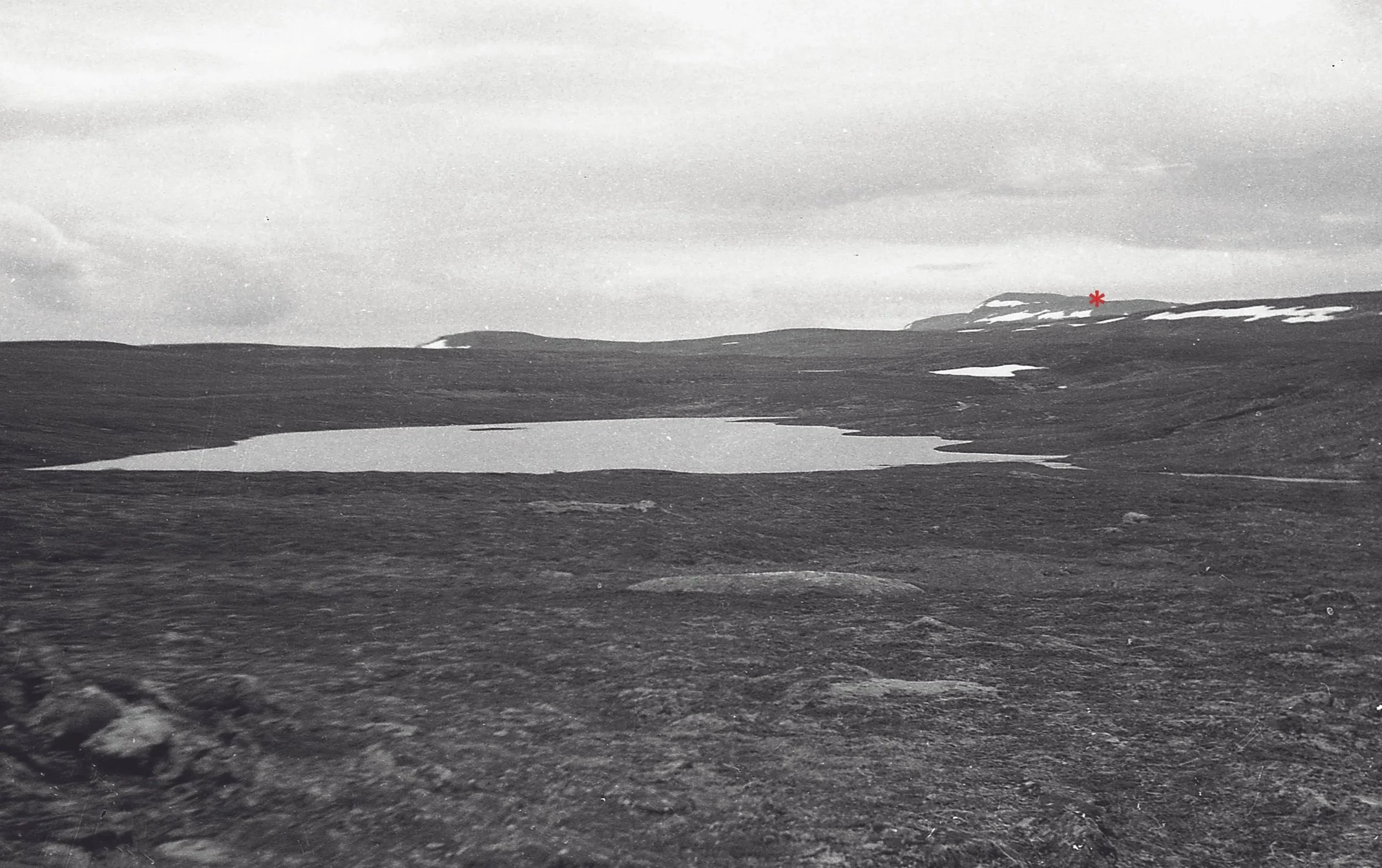
Looking westwards from Ukjent innsjø to Gardevarre (approx. Ju 88 crash-site indicated), August 1976
So I set about looking for my hammer by retracing every rock outcrop I’d examined on the 12th August; but the aloneness of committing to the middle of nowhere incrementally eats into what subsists as a soul. Though I try to suppress it, the doom builds once again while I encircle for the first time the largest lake on my patch – Lake 368 (which I’d named Ukjent innsjø – Unknown Lake). It’s a serene yet eerie place, unusually deep, and – as I remember from trips here a month ago – a playground for nightmares. Gingerly I tiptoe away from the water’s edge; God knows what’s lurking in there. I’m close to panic and to running away, but to where? And where in the hell is the off switch for this paranoia?! Outcrop to outcrop I search until I’m coerced by failing light to stop; I don’t mind failure, but I hate having to give up. It seems like my hammer is not the only part of me I am being forced to leave behind. Two hours later a cup of tea is thrust into my hands as I stagger back into the camp. It has been 22kms; Nigel has been worrying. Oh for a bath, a set of drums, and a comfy bed! Soon!
Three years ago today I climbed the Matterhorn, and 7 weeks ago my friend George – that brilliant nut-head – led Magic Theatre. I told him I was depressed as hell about the imminent trip to Norway and he told me ‘not to be so bitter’.
We both stank. Nigel had joined me in my tent when his Arctic Guinea ripped. I heard the trauma and kerfuffle from my Force Ten. Earlier in the day he had broken down in tears on the summit of Gardevarre. It was bruising to witness. He was desperately missing his girlfriend Barbara. And when it came to geology he wouldn’t cut himself any slack. He was a talented geologist with an unslakeable thirst, but he would sink deep into a dark place when he felt he hadn’t worked out a clear picture of what was going on in the ground. To me his hopes to satisfy his parents’ pride seem conflated with his drive to decipher imponderables Man was not meant to solve so readily.
It became a frenzied night. Beneath the lantern swinging side to side, we were like two agony aunts individually disintegrating, as my tent shuddered in the wind. This was our nadir. He would fire a salvo of woes at me and I would fire a salvo of woes back at him. Where are our ‘heavenly helpers,’ we ask? Maybe it is too early in the year for the Aurora, and why in any event would they come out on such a horrible night? And so without ethereal adjudication our dialogue morphs into a taut exchange between musical instruments: in one corner a xylophone and in the other a piano, first one playing, then the other, and then the two interlocked rising and falling percussively amidst the dissonant strings of the wind as it completes the demolition of Nigel’s tent. ‘I have to get away from here’ I tell him. ‘So do I.’ he replies. It is the breakthrough we both need: we would cut short our time on Gardevarre by four days. She was ripping us to shreds too. We would leave our uneaten canned food for the Sami.
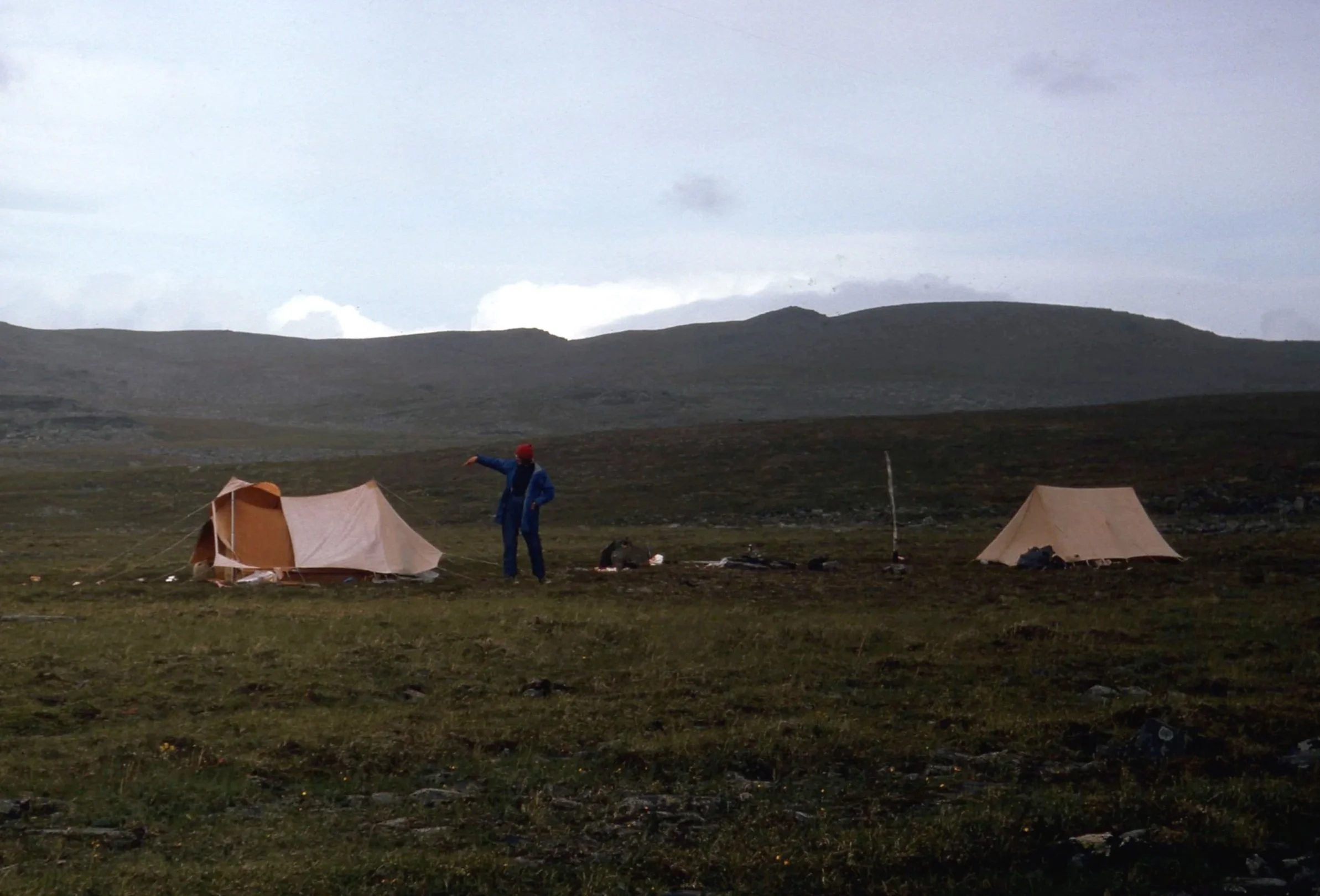
Nigel with his torn tent, Gardevarre camp; 17 August 1976
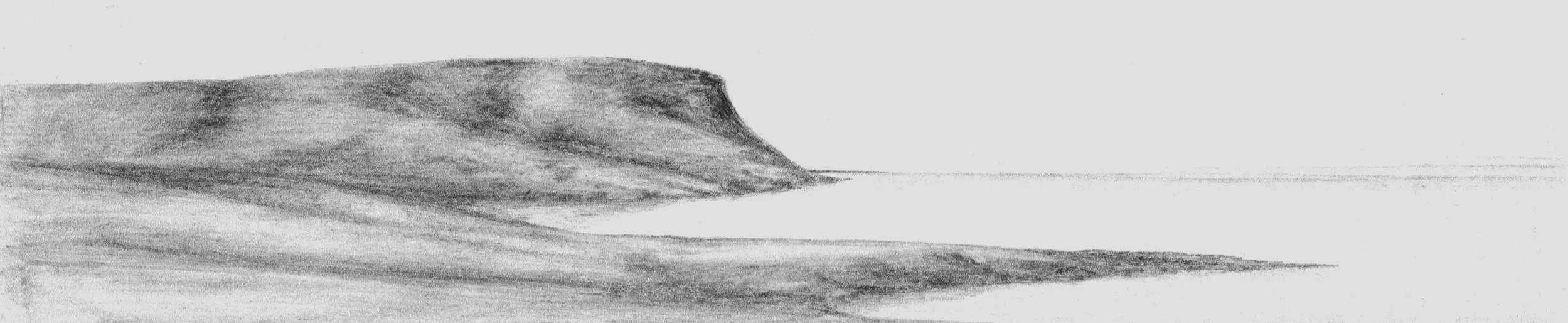
Sieidi; sketched July 1976
From the cabin we took out the university’s boat and, with my bespoke apparatus comprising fishing line wrapped around a pair of reindeer antlers, I was pleased to catch four cod – which I threw back into the sea. Taking the tiller I steered back under the mighty cliffs of Sieidi, that signature headland through which the Nordkapp road burrows via a dank dripping pipe. Nigel and I had climbed a short route here but it was the incredible 200-metre arête that called out. Fortunately we had not brought enough gear to try it!
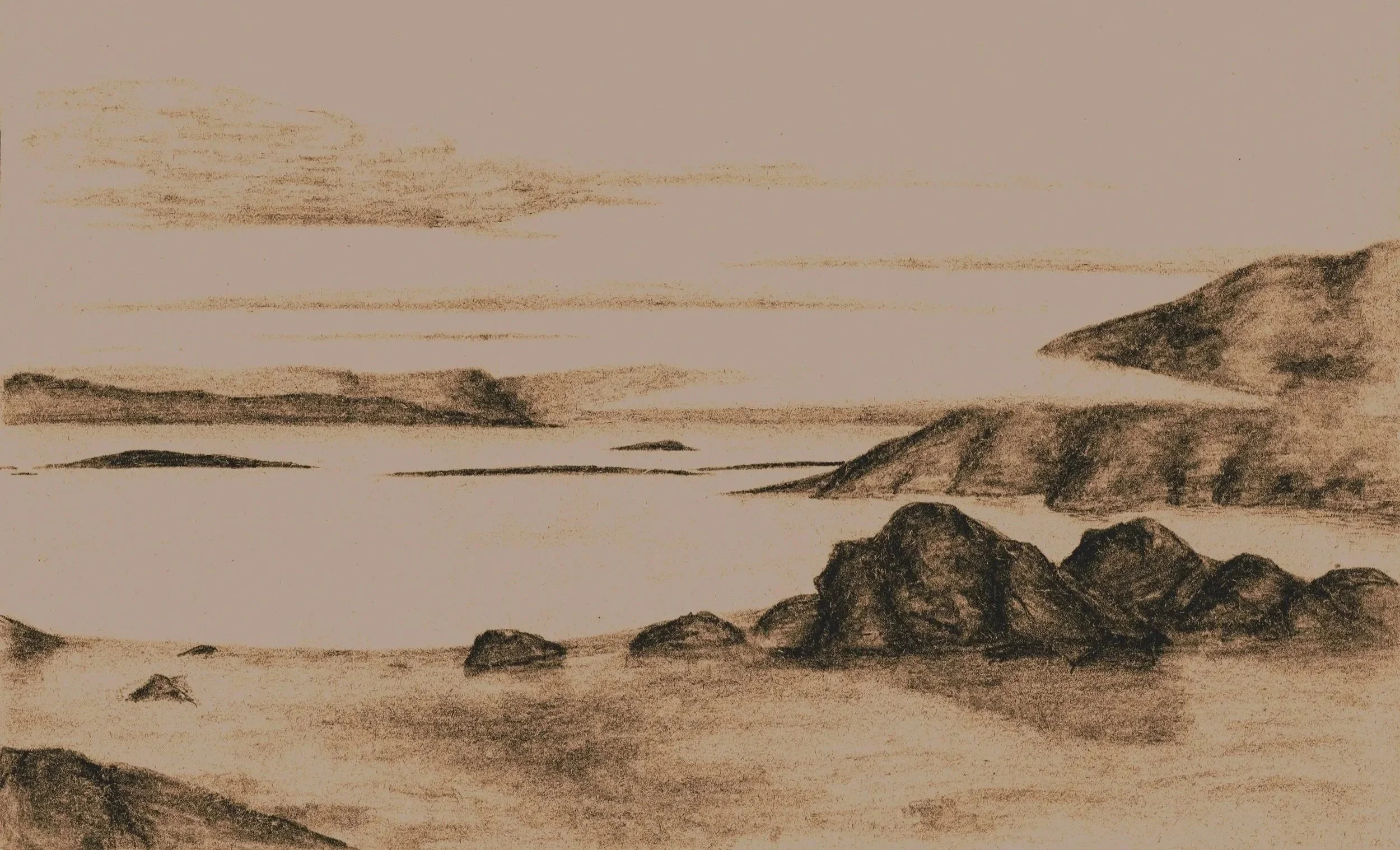
Porsangerfjord, looking south from above Nordmannset; sketched 2.00 a.m. 8 July 1976
Fast forward through claustrophobic cabin-days to 31 August; only three more days to go in Finnmark, and I cannot wait to leave for home! Our stay has been of glacial pace, at times. Feeling liberated, Nigel and I take an evening walk high upon the moors above the cabin which now hosts the full team, though I still prefer a tent outside. It’s a rare crystal clear and starry night-sky and the whole of Porsangerfjord opens up in front of us, from Tamsøya in the north to Børselvnes in the south. It’s extraordinarily calm. We reflect on our times here, conceding now that it might just be possible that we would return one day – a corny-sounding and probably delusional signing off. And as if to say farewell the Northern Lights finally make a surprise showing overhead; it’s what we’d been waiting for all these weeks and months: the joy and warmth of colour. Those spooks of the plateau had at last transformed to light, dancing across the entire Arctic sky – and no one was fighting.
In torrential rain, cowering under a rock, I waited 5 hours for my lift back. Three soggy cigarettes kept me amused, if not dry.
I had goose-bumps, and my heart was beating hard again, this time with the kick of a bass drum as Beverley and I walked into the Norsk Luftfartsmuseum in Bodo, 700km southwest of Gardevarre. In my second rucksack the German aircraft’s steering wheel remained incognito. With palpable trepidation – and much anticipation – I’d been looking forward to this moment for months. It’s only natural as you get older to want to revisit unresolved matters to seek closure – this one was key for me.
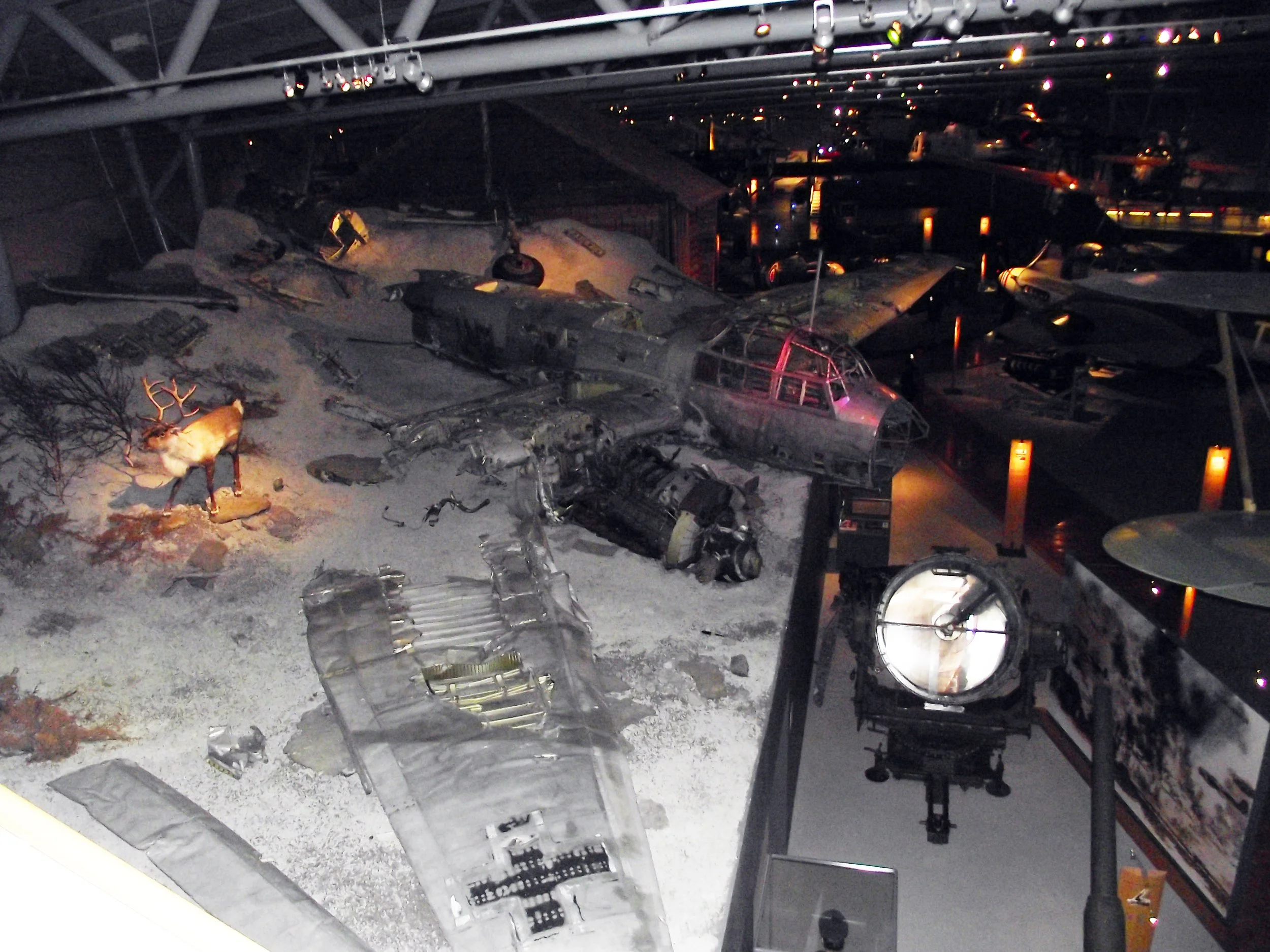
‘I have the steering wheel of a German aircraft on display here that I would like to return to Norway and give to the museum’, I stated flatly to an astonished receptionist. She picked up the phone and made a call. In only a matter of minutes Anders, who introduced himself as the Operations Manager, was by our side in a khaki uniform to hear the story unfold (minus the fantastical context – I didn’t want to appear too eccentric). He guided us into the museum and out onto a viewing platform in the military hall. Before us lay the Junkers Ju 88 set out as it had crash-landed, but here on a reproduction of the Gardevarre hillside illuminated by a spread of coloured lights imitating the Aurora Borealis. I hadn’t seen it in 40 years, except sometimes at night in dreams. Various parts seemed missing like the cockpit framework and notably the pilot’s seat in which Nigel and I sat for pics. I assumed these paraphernalia must have been put to good use back in Finnmark before the salvagers arrived in 1988. The staircase to the platform seemed a suitable place for a formal handover and – with the Junkers in the background – Beverley duly took the photos. When the time came, it was difficult for me to let go of the steering wheel – but Anders pulled harder. ‘This really must be the last chapter’ I told myself. The haunting, the obsession, must end.
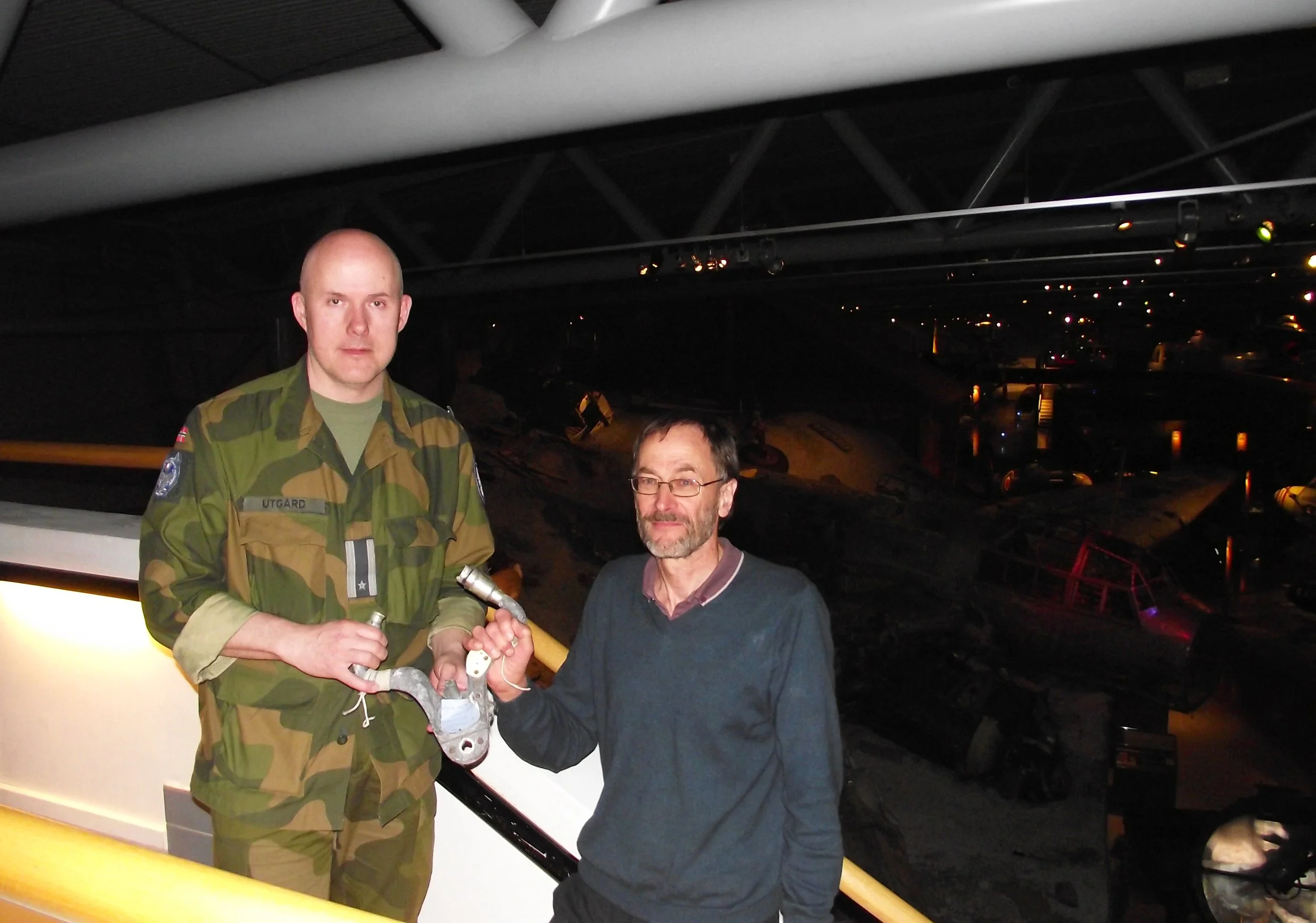
Some day in a few years’ time I will return Nordkapp-bound with my wife. August 1977
A week earlier Beverley and I had stopped for a couple of days in Olderfjord on a round trip anticlockwise through Sweden and Finland, ultimately to drive down through Norway on the E6 back to Oslo, and then across to Copenhagen by ferry. After all these years I was longing to experience how I’d feel here in Porsanger again – but this time with my wife (whom I first met in 1983).
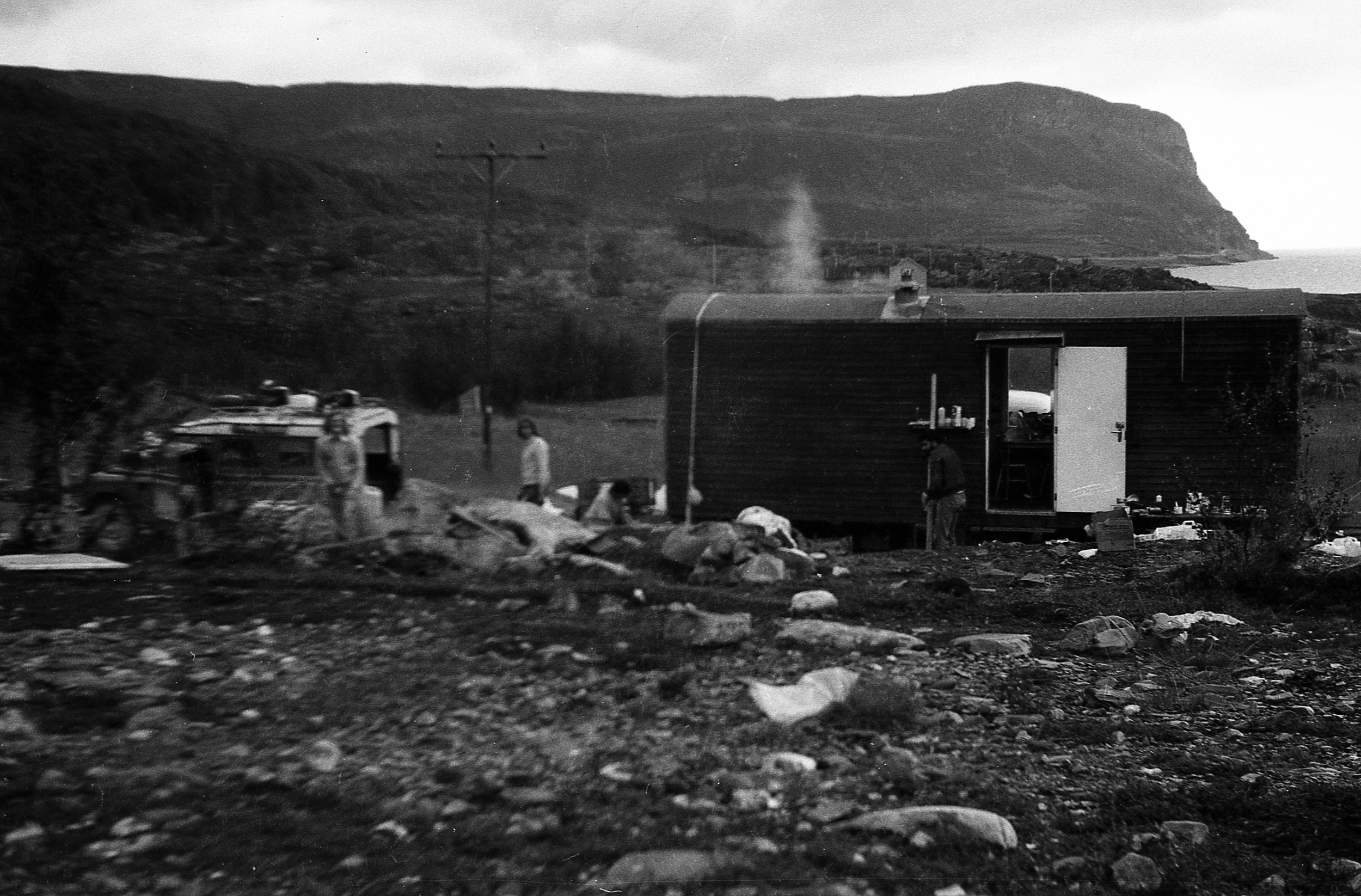
Cardiff University cabin, Nordmannset; 1976
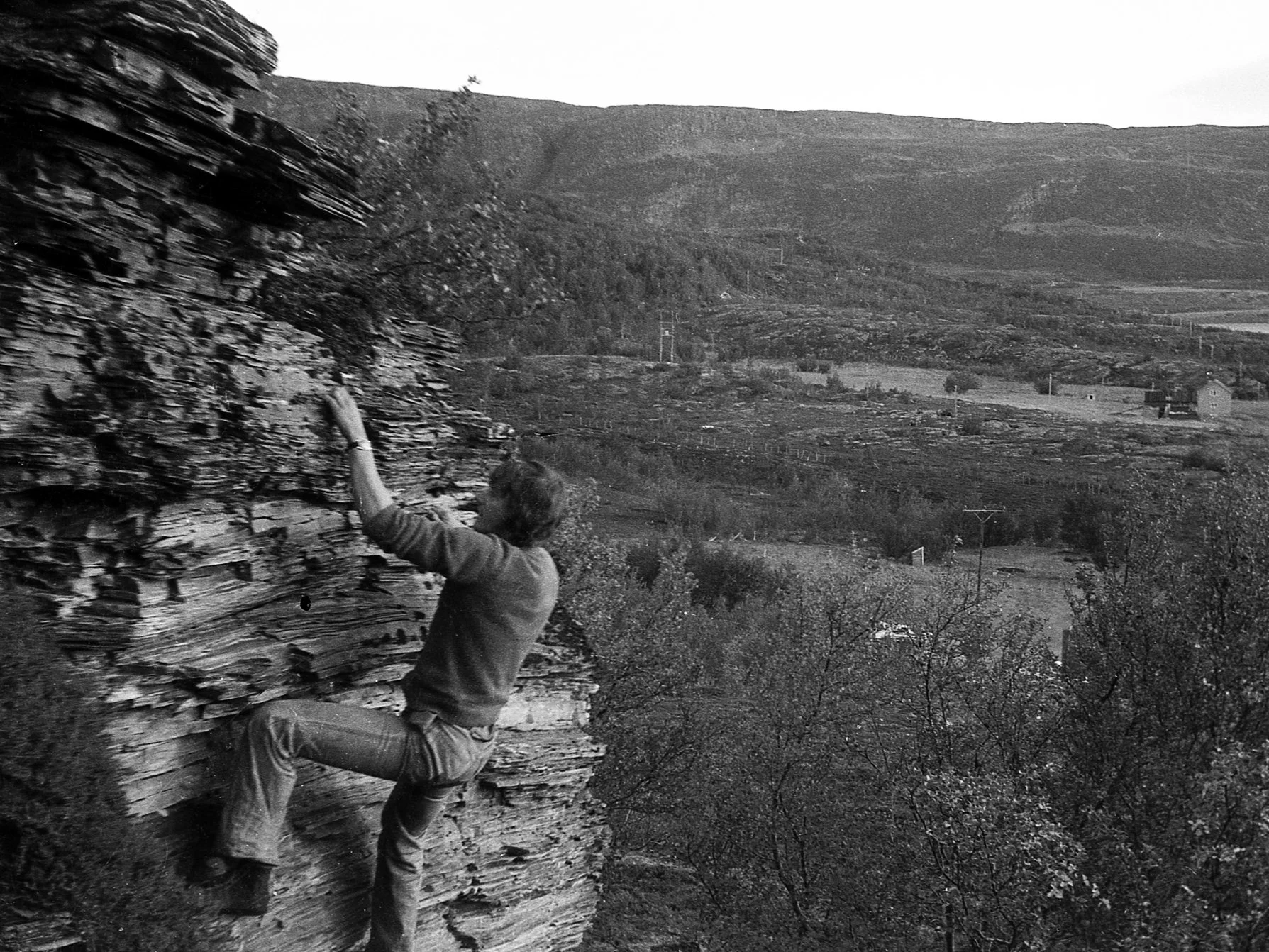
Climbing on ‘Caneallta’ behind the cabin; August 1976
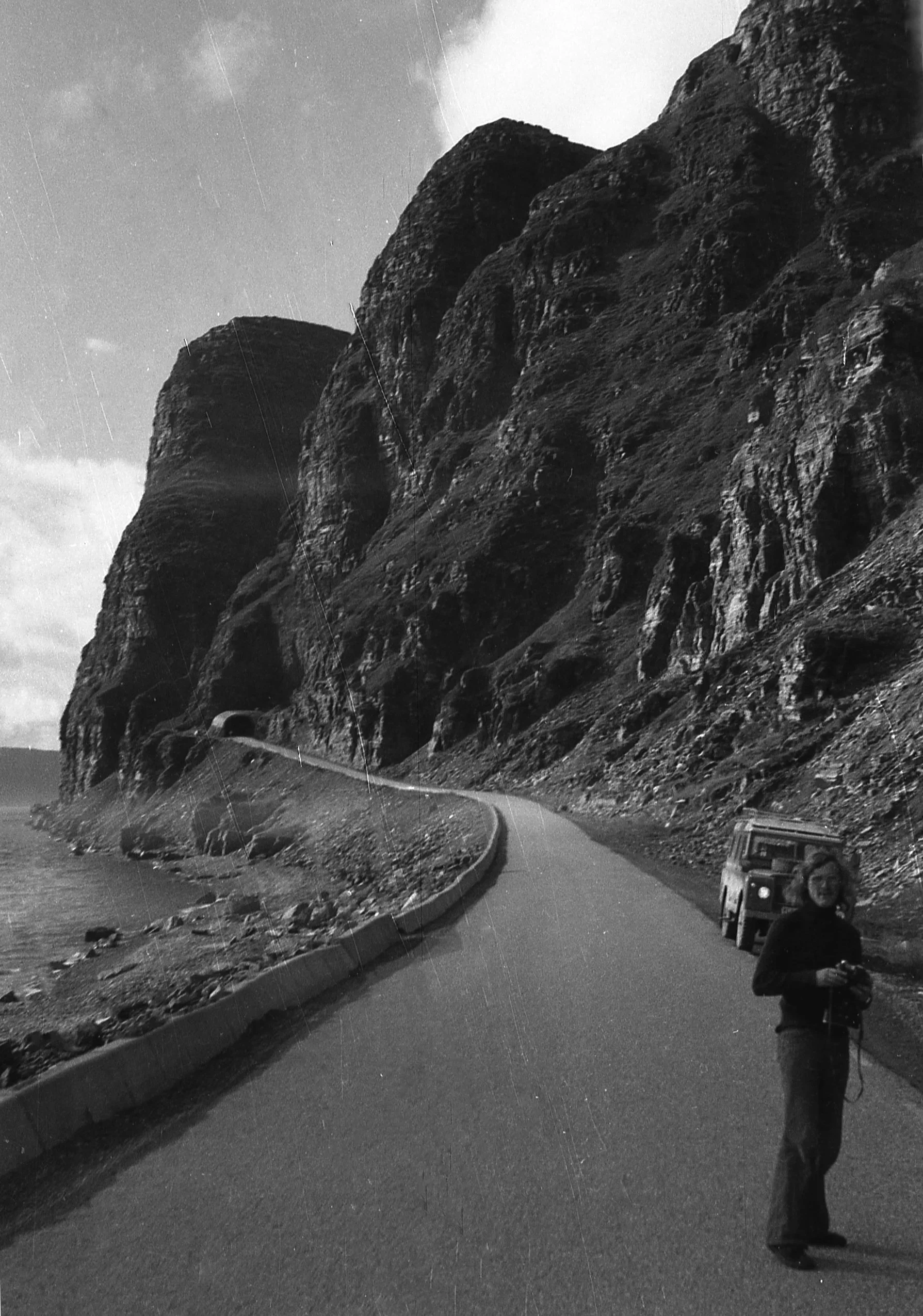
Skarvbergtunnelen, 1976
Soon, we left the path and tramped through heather and 3rd generation reindeer while the great escarpment loomed larger and larger ahead. It wasn’t difficult to find – Camp Crocker – I could sense it, feel it. Everything fitted. The pictures and drawings from 1976 matched what was in front of us right now, and the very same rocks at my feet were those I had used to anchor my tent. ‘This is it!’ I shouted back. Even the stump of a small nearby silver birch that I’d cut for firewood was still here, complete with knife marks. These things seemed a memory box in themselves, perhaps by intention. I whisper a long sigh……it’s both magical and poignant to be able to stand here on the very same spot, the only disconnect being time – fortunately transparent and all too easy to manipulate.
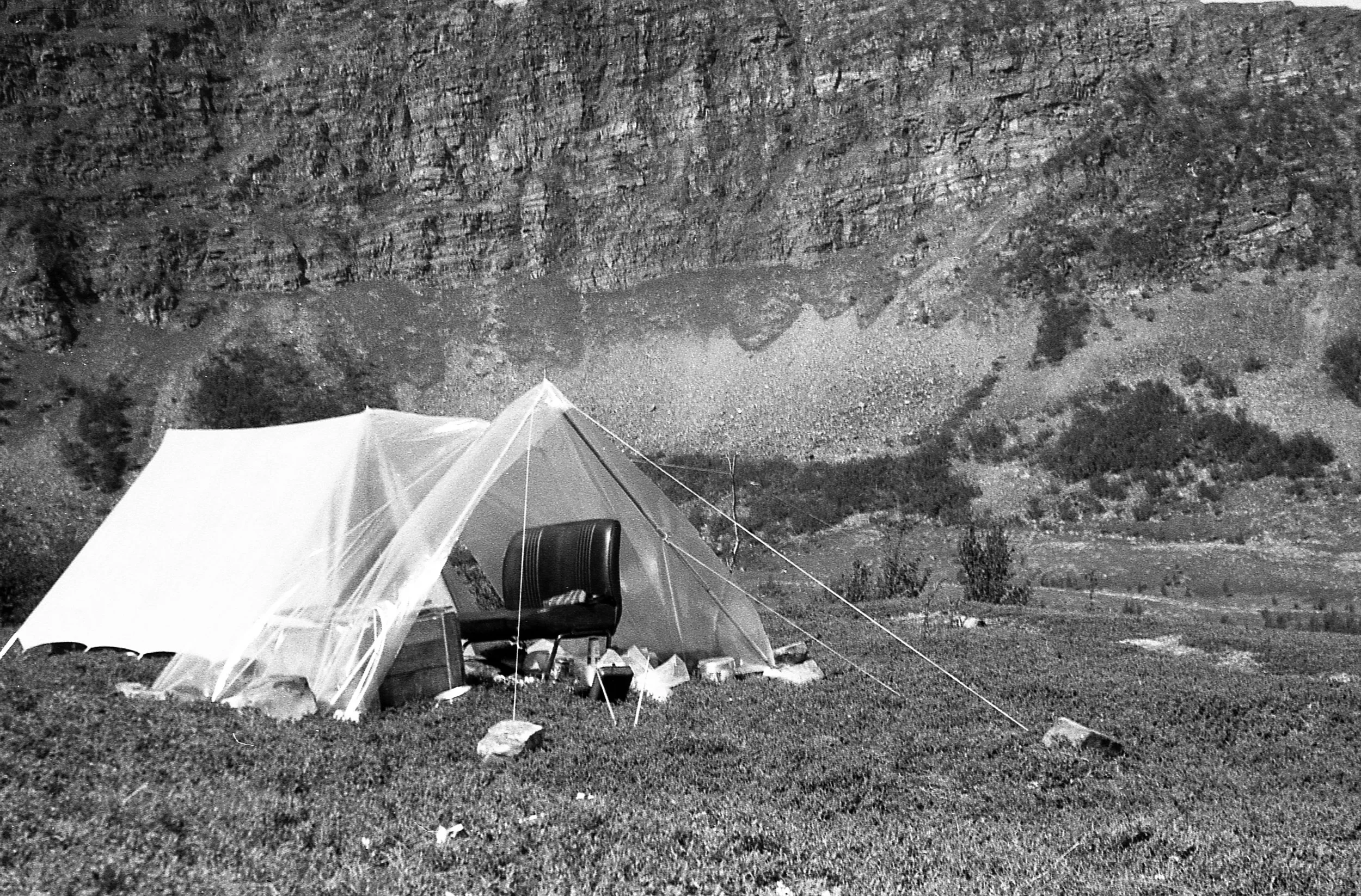
Camp Crocker, July 1976
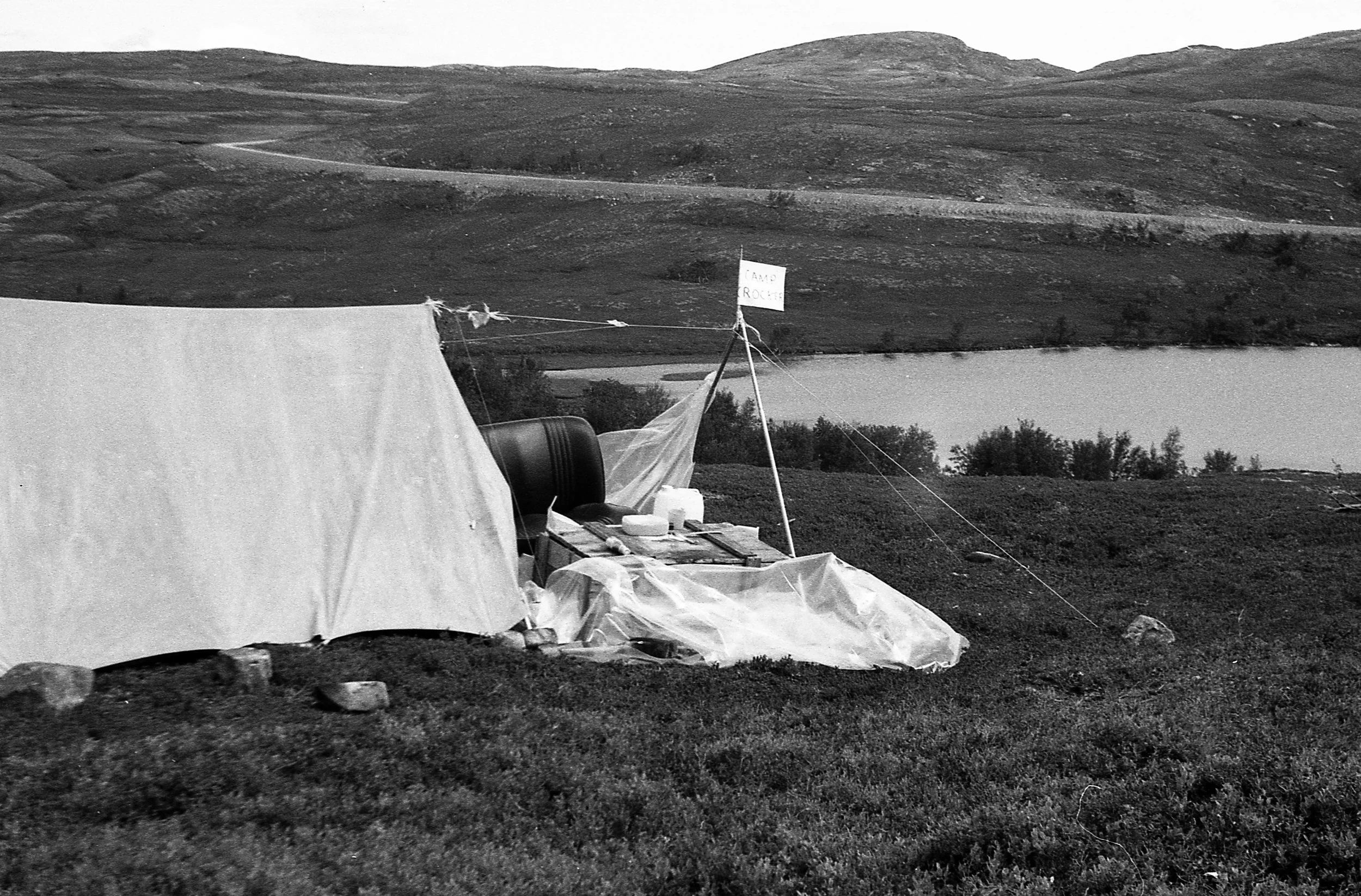
Skarvbergtunnelen, 1976
Camp Crocker, July 1976; after a stormy night.
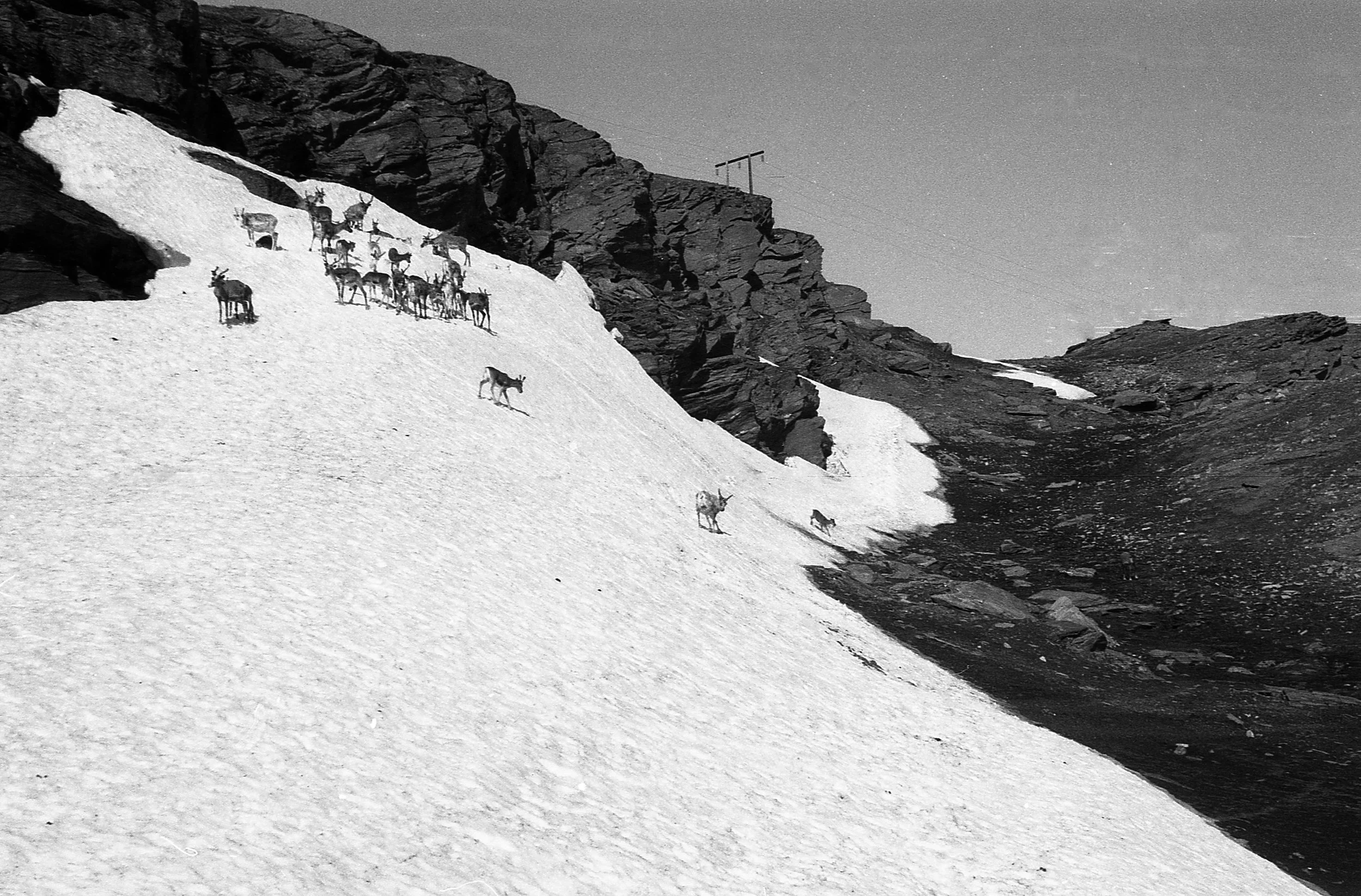
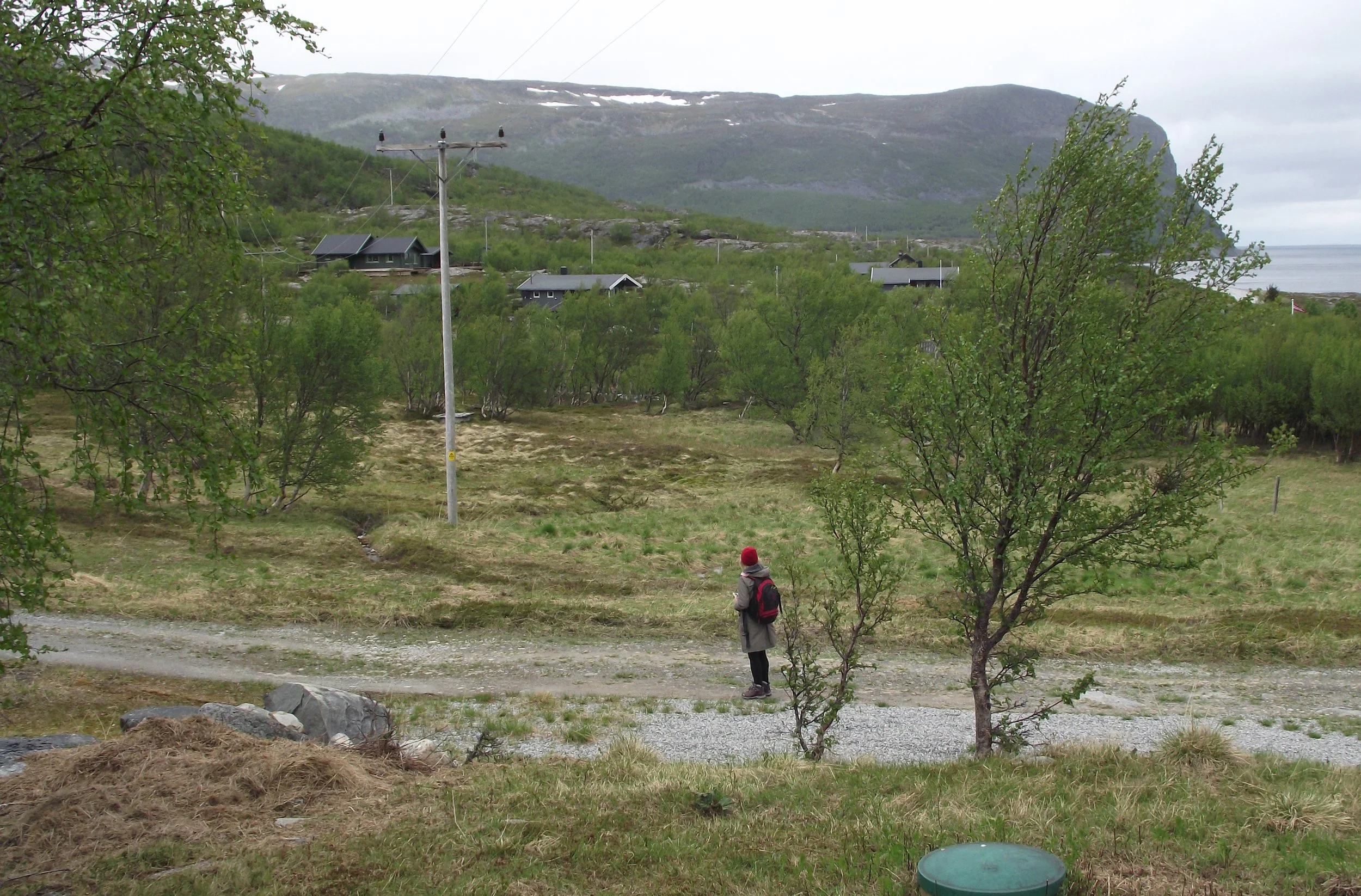
The cabin is long gone; 2016
Same route, 40 years on
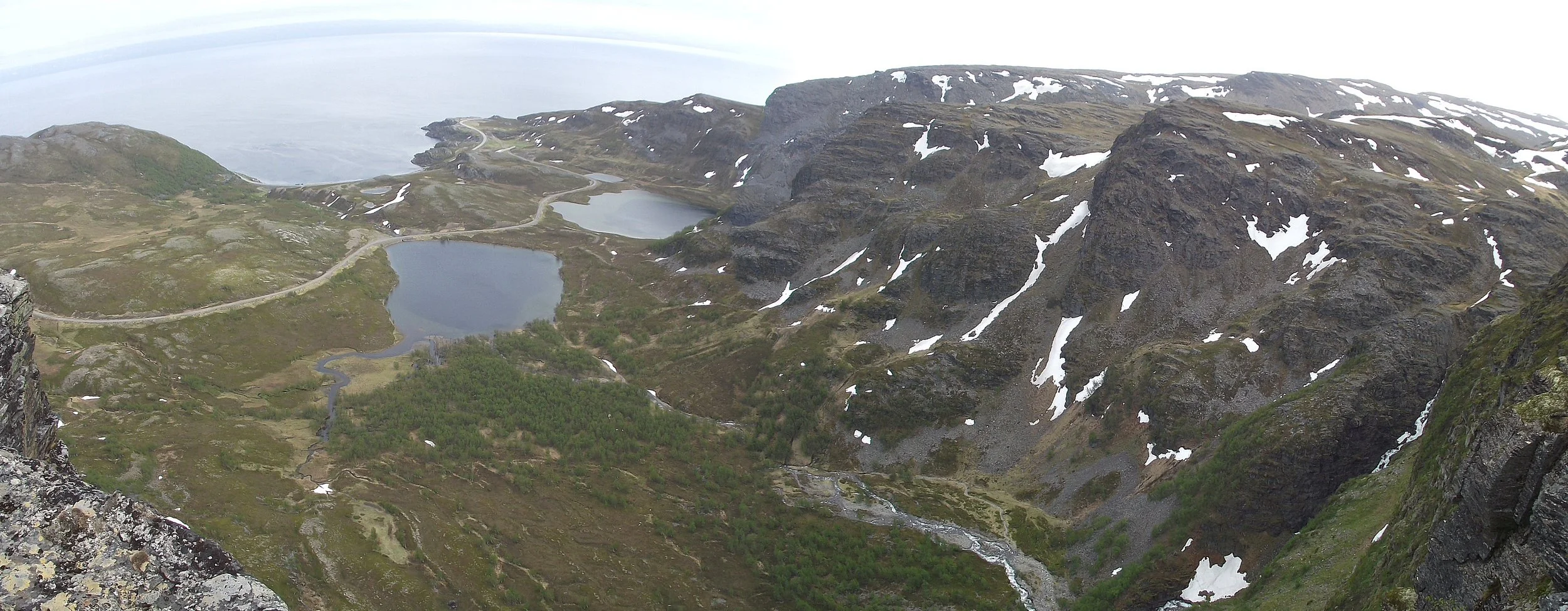
After a stop-off in Nordmannset to revisit the site of the long-scrapped university cabin and the nearby 'Caneallta’ bouldering crags, we set off north along the coast road and through the 3.6km tunnel of Skarvbergtunnelen towards Camp Crocker. In my day the tunnel was an unsurfaced and squalid thing with a dripping roof and no lighting – rather like a Mendip Hills cave, and just as scary. Now it is palatially equipped with tarmac, signage, and lights – but it still drips. Beyond is the deep bay of Skarvberget where Nigel had camped in 1976 and towering over it a headland – Skaw – which marks the southern limb of my patch, behind the bay of Indre Sortvik. Here, there are two lakes; I had camped next to the northern of the two, Cahcevagejavrrit. I knew beforehand from Google satellite imagery that the upgraded E69, which had originally passed inland close to the lakes, had been diverted along the sea’s edge in order to help conserve the area. So we parked-up and, under-dressed, started the walk along the old road – now a footpath – turning to face backwards for good reason. That’s because the iciest of northerly winds, that most loyal of adversaries, had greeted us with full-on 70s fury. ‘Sorry, we should have brought more clothes’, I admitted to Beverley. (I was meant to be the expert, yet only the day before we’d been sweltering in northern Finland where the temperature was approaching 30 degrees Centigrade.)
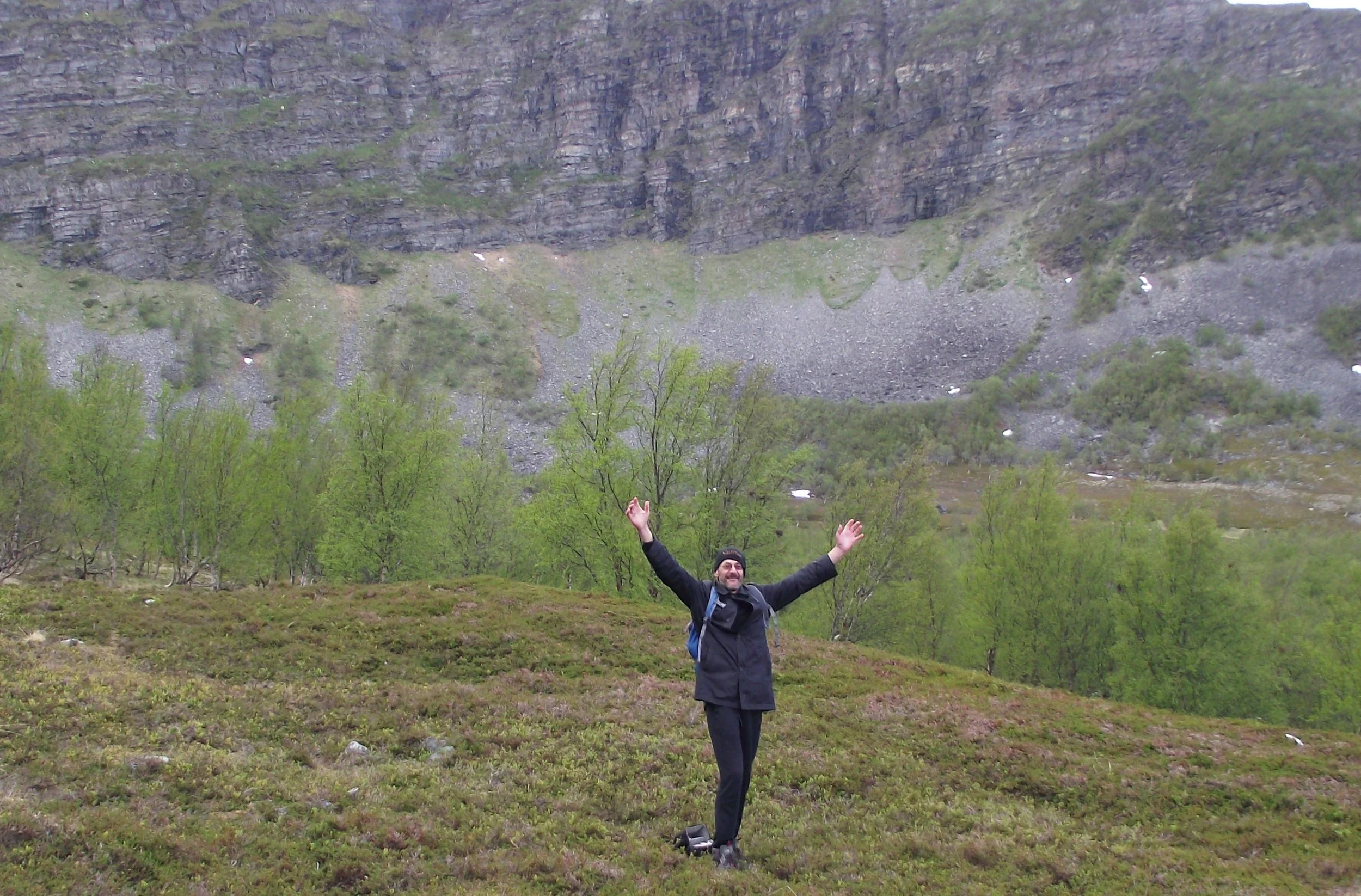
June 2016
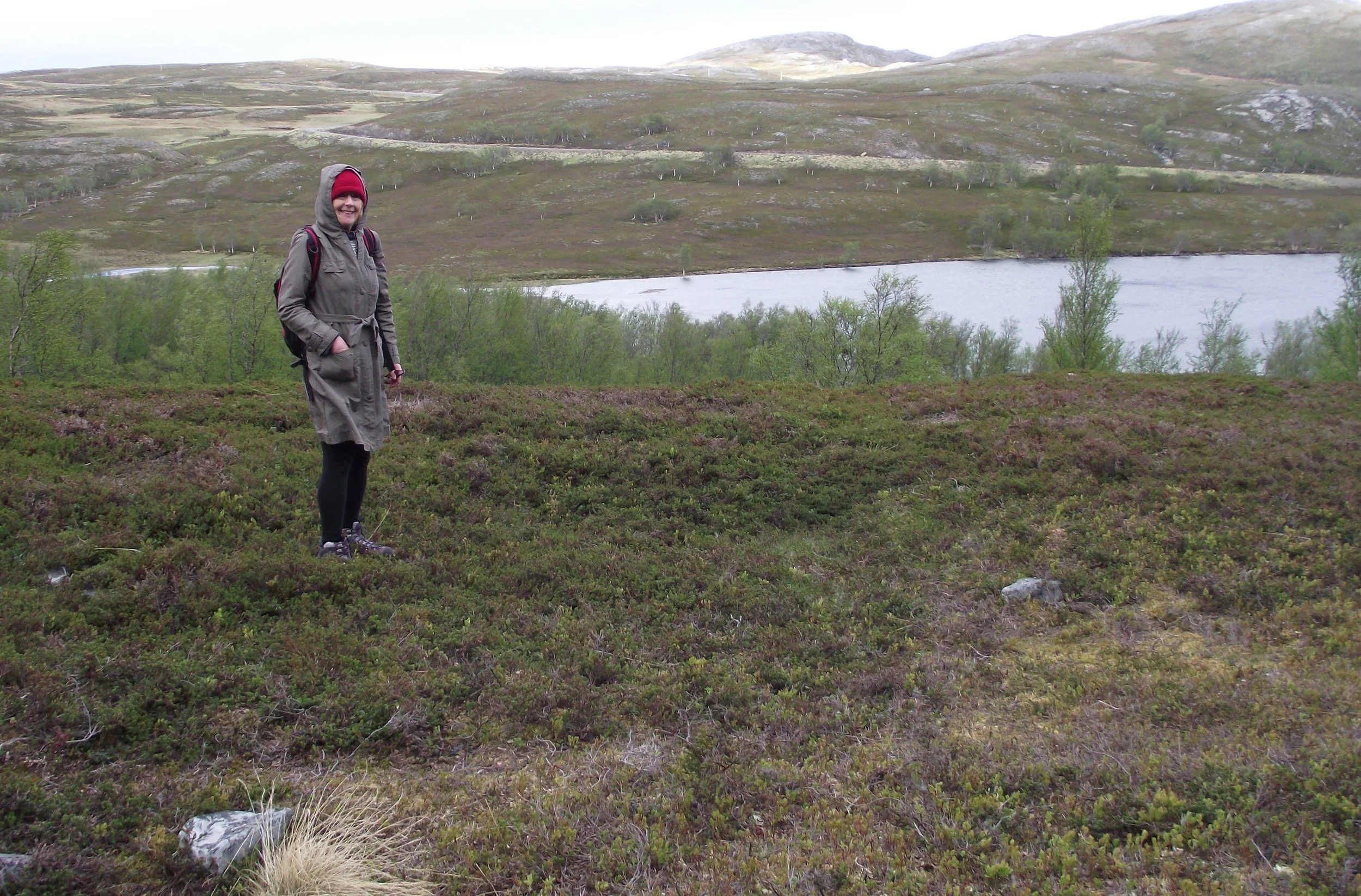
June 2016, chilled by harsh northerlies.
Relax, at long last it is time to surrender to transcendence, and to piggy-back Sami psyche and spirituality, even Bifröst itself; reaching out, and back 40 years, accepting the risk that communications could well become garbled, scattered, atomised by AI, tech, and the rest of the garbage littering the skies. We may have been aspirant scientists, yet Nigel and I were never truly sure what was real here and what was not. Either state of reality could encroach on the other at any moment, mixing cultures and mythologies, discarding linear time. If the area’s geology could turn Earth history upside-down why should it not be able to fold human perceptions of time too? It’s an enthralling thought: the fact that, standing here, Beverley and I are further away in time from 1976 than the crash of the German aircraft was in 1942. So far as I was concerned no one can be certain that in1976 I was not sensing the same consoling messages that were being sent back this very minute. And that the life outside the tent that stormy night was only me. Although a yearning now, I can’t say for sure I didn’t realise then. Just ask the Gods. Any available god will do.
The next day, our last in Finnmark, Beverley and I follow the necklace of telegraph poles over the escarpment and onto the quartzite top of Mystic Tor. Far in the distance, above and beyond the lake of Galbenjoasjavrit, lay Gardevarre, almost completely snow-covered. I stoop to pick up a broken antler from a crack in the boulders. The shakes start again. This is the final chance to find my hammer.
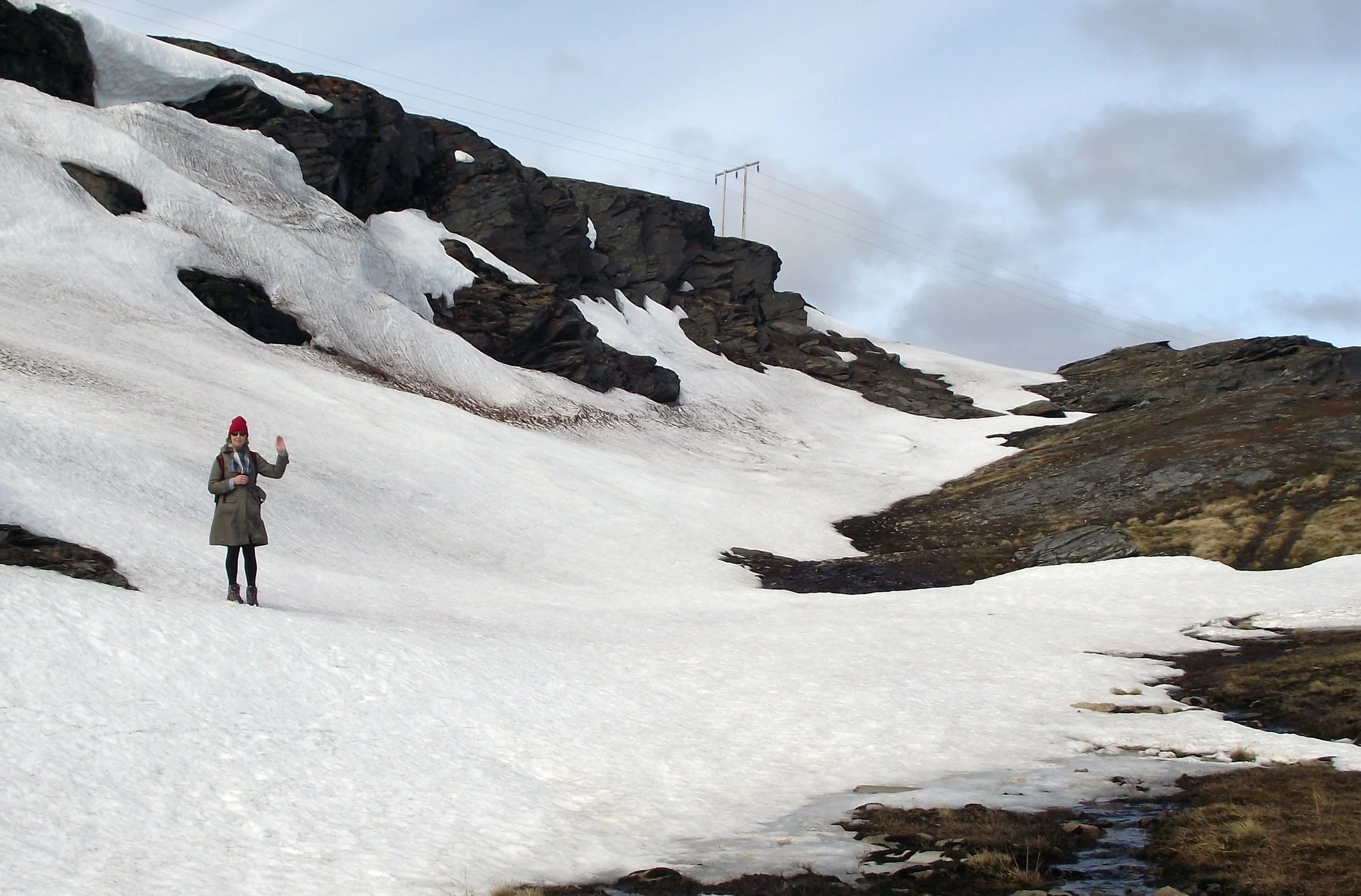
Above: telegraph poles trek across the plateau south-westwards in a line towards Olderfjord. They follow a huge ramp up the escarpment, above Boahccman-varri, which provided a standard and safe way onto the inner plateau in 1976.
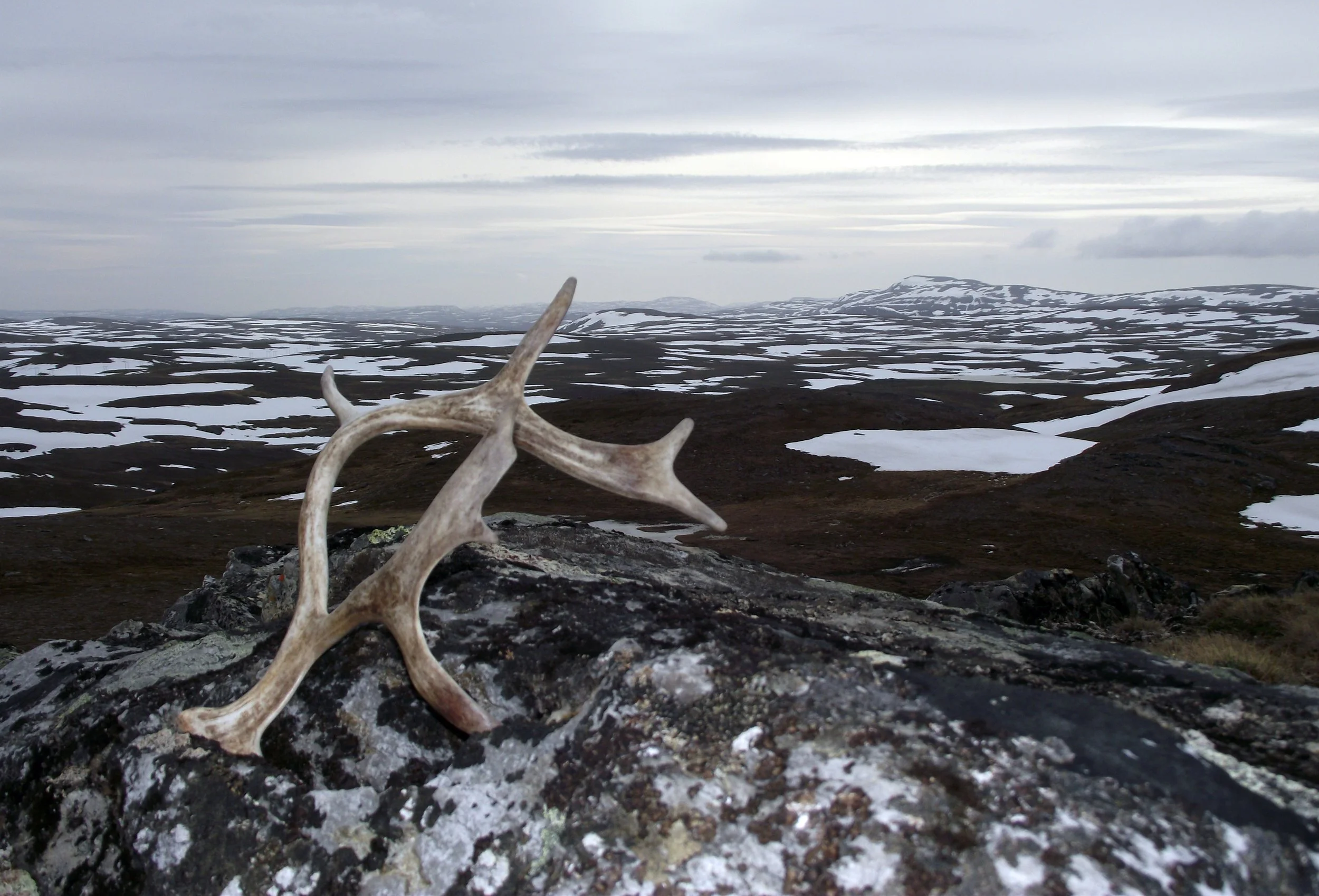
Gardevarre from Mystisk Topp (Mystic Tor); 2016
Postscript
We understood the main aim of the Junkers Ju 88 in Norway was the bombing of allied Arctic convoys in order to disrupt the flow of military equipment and other supplies to Russian ports. Nigel and I asked around shortly after returning to the UK, but I cannot recall that we acquired much additional information. All the while the steering wheel was being stored in my garage serving no public benefit whatsoever, only my personal indulgence. In 2015, while planning my wife’s and my 2016 Scandinavian road-trip, I searched the internet again regarding the aircraft and Gardevarre, and discovered that the remains of the aircraft had been on display in Bodo’s aviation museum since 2003. The feat to relocate the wreckage (in 1988) impressed me, and I immediately became excited about the idea of returning the steering wheel to Norway. As well as providing a climax for our trip, I hoped that the reunification would conclude a compelling story, which in 2016 would have spanned 74 years.
The internet searches also revealed more about the circumstances of the crash, including technical information on the aircraft, some of which I reproduce from the Norsk Luftfartsmuseum website as follows – with thanks.
‘The Junkers Ju 88 became for the Germans what the Mosquito was for the British: a very versatile aircraft in many different roles.
The Ju 88 was originally designed as a high-speed bomber. The prototype was on the wings in 1936, and the aircraft type was operational in 1939. During the Second World War, ten different variants were produced, including bombers, night fighters, reconnaissance aircraft, dive bombers, torpedo bombers and close support aircraft for the army. More than 15,000 examples of the Junkers Ju 88 were built.
The Air Force Museum's Junkers Ju 88 has the additional designation A-4. This type of aircraft was produced from 1942 and was further developed for attacks on shipping traffic. The Germans had many squadrons of Ju 88s in Northern Norway. Their main task was to bomb the Allied convoys traveling between Great Britain and Murmansk, and the aircraft was partly responsible for the sinking of 32 Allied merchant ships in convoy off the coast of Finnmark in less than two months.
The museum's Junkers is a Ju 88 A-4. The aircraft on display had the markings 4D+AM and was stationed at Banak in 1942. [The military code 4D identifies the aircraft as part of Kampfgeschwader 30, a Luftwaffe squadron assembled in northern Norway specifically to tackle the allied Arctic convoys. The aircraft’s serial number was 1478.] After attacking the Russian [merchant] vessel Kiev and the [Panamanian merchant] vessel [El] Occident on April 17, 1942*, the plane ran out of fuel on the return trip to Banak. The crew of four parachuted out near Hammerfest, and the plane crashed at Gardevarre in Smørfjord. All four crew members were uninjured.’ [According to flyvrak.info the belly gondola with its machine gun, fell down on Snefjellholmen (where the crew bailed out). It was hidden there by a Sami.]
[*I have read on other websites that the crash occurred on 13 April 1942. This seems to tally with records of the sinking of both Kiev and El Occident by U-boats early in the morning that day. The two cargo vessels were part of Arctic Convoy QP 10, which departed on its return trip from Murmansk to Reykjavik on 10 April. As soon as the convoy set sail it came under attack by Ju 88 bombers and U-boats. The cargo ships Empire Cowper and Harpalion were attacked by Ju 88s on11 April, the former sinking that day. The Arnold Hague Convoy Database records ‘damage’ to Kiev from ‘aircraft’ (presumably Ju 88s) which may have included 1478 (perhaps early on the 13 April before the U-boat sank both Kiev and El Occident?). Assuming the crew parachuted out as described above, the aircraft must have been about 80km northwest of the Luftwaffe’s airbase at Banak when it ran out of fuel. I know next to nothing about flying (or ditching) an aircraft, but it looks to me that its final sou’-sou’- east trajectory towards Banak accords with the aircraft’s crash position, its cockpit facing broadly southeast and tail northwest i.e. its fuselage oriented at right-angles to the Gardevarre ridge. Unmanned, it must have glided down just to the north of Gardevarre’s summit, and onto the fairly level, gently rising ground. I have looked through the Ju 88 crash records on the Aircrew Remembrance Society but, while I can find notes on the loss or crashes of other Ju 88s in Norway on the 13 April, I cannot find any reference to 1478. However luftwaffe.no records the crash of 1478, but details of its crew are absent. I’d be fascinated to learn more. ]
‘The airplane is displayed approximately as it was found at Gardevarre. The paint is worn after 40 years of weather and wind, but originally had the original splinter camouflage pattern RLM 70/71 with underside in matte black. Black markings with white A as the aircraft's individual letter according to Staffel.
The fuel tanks are gone. The square holes in the wings are there because everything of value was stripped from the plane by the Germans themselves. Gasoline was a valuable resource, and all the tanks were gone when the plane was retrieved.
The rudder was found. The plane lay for many years on the Finnmark plateau before it was brought to the museum. The plane lay exactly as it had crashed during the war, but a number of things were missing. A hiker had seen the plane years before and brought the rudder with him as a souvenir. When he saw the plane at the museum, he came and delivered it to the collection. The rudder is now on display in the museum.’
Author’s Acknowledgements
Nigel Watts, Beverley Crocker, Norsk Luftfartsmuseum, the Cardiff University team and its mentor Rod Gayer, and the people of Porsanger.
The 1976 text is built and quoted from a journal, kept daily – which helped recentering.
This essay was first published on 11 August 2026 on martincrockerclimbing.com , in PDF format. That was 50 years after our coming across Ju 88 1478.
Artwork (real-time sketches) ©Martin Crocker 1976
Photographs ©Martin Crocker/Nigel Watts; Beverley Crocker
Healing Gardevarre ©Martin Crocker 1976, 2026
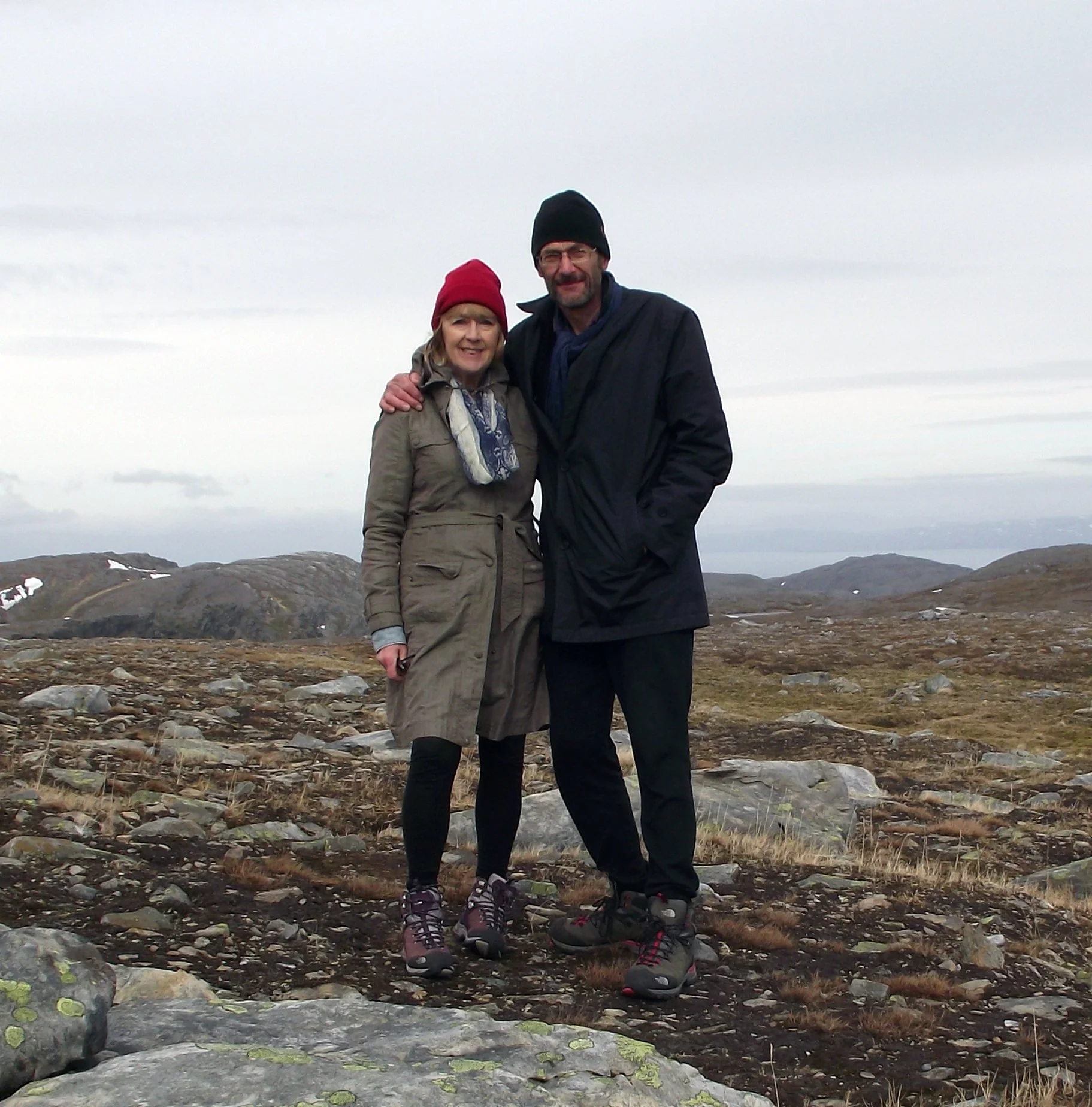
We look forward to returning in 2036